MikeC
Admin
Reged: Sun
Posts: 2779
Loc: Orlando, FL 28.49N 81.47W
|
|
4:50 PM August 2006
Chris has held itself as a Tropical Storm today, but is still fairly organized, it has weakened a hair due to a bit of shear, but likely will recover somewhat overnight.

The forecast track was shifted slightly south today because of more models coming together. There is still a great deal of uncertainty past a few days. The most likely track still places the system into the Florida Straights, but the cone reaches toward Central Florida south through Cuba. Anyone from Cape Canaveral on the east coast into Cuba needs to continue to watch this system. It's small size will likely keep the affected area relatively small.
Hurricane Watches are up for the Turks and Caicos Islands.
See Clark's blog below for more details.
11:30 AM August 2006
The latest Advisory keeps Chris as a strong Tropical Storm, however some models are starting to get a better handle on the environment around the storm. The ridge to the north may cause Chris to stay further west, and possibly over Hispaniola, but there is enough uncertainty that I think that anyone in the Cone needs to watch, from the islands to the south to Southern Florida.
More to come later.
7 AM 02 August 2006
Based on Recon Reports, Chris is gaining toward Hurricane Strength, with near 65-70MPH winds now.

Chris has gained better structure overnight, but is listed as a medium to strong Tropical Storm wtih 60MPH winds. What is striking about Tropcial Storm Chris is how small it is, relatively. It is a compact storm and has the ability to spin up with winds (or spin down) very quickly. So intensity forecasts are about useless. That said, it does have the potential to become a major hurricane at some point, as it looks like it will indeed thread the needle between the upper lows. Doing so will actually enhance outflow, and give the system a chance to spin up.

Other factors could cause it to spin down too, such as a bit of dry air, but again since Chris is a compact system, it has a better chance of not being affected by that. Expect possiblity drastic fluctuations in intensity with Chris, both up and down.
The forecast track has shifted a bit more north, most models still are having a problem initializing Chris because of the small size, this means most models are nearly useless at the moment, but this may change.
Because of the model uncertainty, and the general uncertanty with intensity, Chris must be watched closely. Chris is a big cheater with the usual round of model predictions. If anything the current forecast track is a bit too far south, but if you are in the cone, you should at least monitor the situation. We still have a few days yet to get a better idea of where Chris will go.
Original Update
Tropical Storm Chris has strengthened during the day to a 60MPH Tropical Storm, it is now forecast to become a hurricane and skirt north of the Caribbean islands and enter the Bahamas. This places the cone of uncertainty well into south Florida, and will force everyone to watch this over the next several days. Currently it is more likely for the track to error north than south, but there are many factors invovled.
Folks in the Caribbean will want to watch it, as well as the Bahamas, and Central to South Florida should maintain vigilance on Chris.

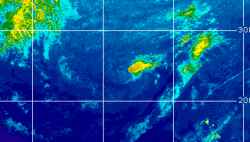
Over the course of the afternoon, Chris decided it wanted to develop a Central Dense Overcast, type of feature. Complete with banding patterns typically associated with moderate to strong tropical storms. And Lo and behold, that's what we have right now. As noted in Clark's earlier blog post below, Chris will likely have intensification in fits and spurts for the next couple of days.
There willl likely be a bit of leveling off into the early morning hours before the next "leap" (if you will) of organization takes place -- before we see steadier intensification. This, of course, assumes that the storm stays off of Hispaniola. The only way it does not do that is if the ridge builds in much stronger than forecast, which is possible but is not very likely.
Even if there is a trough fracture-induced upper low that forms in a few days behind Chris, it is not going to affect the forecast thinking from the earlier blog...and may even provide another outflow channel to worry about. Clark is already starting to get worried about the organization of the storm leading to better outflow to the north and west in the short-term. Persistance and what happens there first is key before getting to the long term.
There isn't much to keep it from organzing more other than the standard organizational hurdles.
The Upper Level Low pressure area near the Bahamas, is already starting to retrogress; the trough it is connected to that extends on an east-west line some distance north of Chris should lift out in the next day or so.
In short, this means a major hurricane is possible from this one in the next 5 days while a storm of at least minimal hurricane intensity is likely in the next day or two. How strong the ridge builds in will determine the track forecast over the next 4-5 days and what parts of the extreme southwestern Atlantic need to worry; the intensity of the storm plus the timing and location of any waves in the flow aloft will determine what happens if and when Chris gets into the Gulf.
Overall, the National Hurricane Center cone width looks good, but Clark would shift it all about 100 miles to the north at 5 days. This means everyone in the Bahamas, Greater Antilles, and Florida needs to watch this one for the weekend...points beyond Florida will have to wait..
Event Related Links
StormCarib - Reports from the Caribbean Islands
Caribbean Weather Observations
Radar Imagery
Flhurricane long term radar recording of Chris
Flhurricane/HCW long term High Resolution Level 3 Radar Recording of Chris
San Juan, PR
Martinique Radar
Model; Plots (More at bottom of main page):
"Spaghetti" style model plots from Colorado State / Jonathan Vigh
Chris:

Animated Model Plot
Animated Model Plot of Chris
Google Map Plot of Chris
SFWMD Model Plot
Visible Satellite Floater
IR
Animated Floater with overlays
More Satellite Images of system
|
CaneTrackerInSoFl
Storm Tracker
Reged: Mon
Posts: 395
Loc: 25.63N 80.33W
|
|
New Advisory in...
Nothing new, basically all the same as before...
Chris is moving toward the west-northwest near 10 mph...17 km/hr...
and this general motion is expected to continue during the next 24
hours. On this track...the center of Chris will move near or over
the northernmost Leeward Islands tonight and early Wednesday.
Maximum sustained winds are near 60 mph...95 km/hr...with higher
gusts. Some strengthening is forecast during the next 24 hours.
Another Air Force reconnaissance aircraft will investigate Chris
during the overnight hours.
-------------------- Andrew 1992, Irene 1999, Katrina 2005, Wilma 2005
|
Tony Cristaldi
NWS Meteorologist
Reged: Fri
Posts: 39
Loc: West Melbourne, Florida
|
|
NRL site says there was a 0206UTC (1006 PM EDT) pass of the TERRA polar-orbiter 399 miles from nadir (directly over the storm). The MI images from this pass should be available within the hour and give a decent presentation of the center.
|
dem05
User
Reged: Wed
Posts: 368
Loc: Port Charlotte, FL
|
|
Okay, now I'm feeling a bit confused and would like to ask for a hand...
The 11:00 Discussion mentioned that a track to the north of the current forecast would induce higer shear. How so? I'm figuring it is based on those models, but they haven't been that great so far...Ideas?
Looking at the satellite, I've been hunching that this system has reformed/motioned north of the advisory...but I haven't seen latest radar. What are you seeing gang?
Edited by dem05 (Tue Aug 01 2006 11:25 PM)
|
CaneTrackerInSoFl
Storm Tracker
Reged: Mon
Posts: 395
Loc: 25.63N 80.33W
|
|
Looking at the satallite it appears the convection is just bulging towards the northwest. Not sure if this is indicative of movement.
http://www.ssd.noaa.gov/goes/flt/t1/loop-rgb.html
Floater Page-for slow connections
Edited by danielw (Tue Aug 01 2006 11:49 PM)
|
Random Chaos
Weather Analyst
Reged: Sat
Posts: 963
Loc: Maryland 38.98N 76.50W
|
|
One thing I'm noticing is that the model runs aren't initializing this storm very well yet. We might get better tracks come morning when the stronger TS conditions propagate into the more detailed model runs (many of which rely on global model runs 6-12 hours earlier). I recall this from last year. Until you got a strong TS, you didn't get good initialization of the models. I suspect this is in part why the is keeping the track just north of the model concensus.
--RC
|
weather_wise911
Weather Hobbyist
Reged: Mon
Posts: 82
|
|
This storm only continues to look more and more impressive.
There is no doubt in my mind, that by late tomorrow evening, or tomorrow night...... we will be posting of Hurricane Chris. As the has been mentioned, the convection is directly over the COC, and Chris continues to organize, fairly rapidly.
That being said... I feel that the 60 mph wind speed in the 11 P.M. advisory is still a bit conservative, given the level of organization, and convection being directly over the COC..... I`m thinking surface winds are likely closer to 65-70 MPH.
Whats say you?
WW-911
Edited by danielw (Tue Aug 01 2006 11:46 PM)
|
dem05
User
Reged: Wed
Posts: 368
Loc: Port Charlotte, FL
|
|
I was thinking this NW bulging idea might be an explanation when I posted the question too...but I think something has happened here short term in the track. I pulled up the floater and clicked on the radio buttons for Lat/Lon and Trop Pts above the image....The Trop Pts are not valid as of 11PM right now, but the shield is almost totally north of that path now, which meands it has broken off the consistent 195 degree vector that was going on all day and is heading on a vector a touch north of that. I placed the Lat/Lon on there 'cause the difference between the 8PMand 11PM advisory was 0 degrees north by.2 degrees west. Hmmm. Hurricane Center prepares position estimates for advisory packages, the 11PM was an estimate from 8PM fix I think it ended up moving further north than the actual advisory folks.
Edited by dem05 (Tue Aug 01 2006 11:57 PM)
|
weather_wise911
Weather Hobbyist
Reged: Mon
Posts: 82
|
|
There are alot of things happening, in a short period of time with this system.
You going to get little "jogs", and odd movements...... some that could last for quite a while.......
I see nothing that would indicate the storm will stray off of the FRCST track....... not ATTM.
WW-911
|
hurricaneguy
Weather Hobbyist
Reged: Fri
Posts: 80
Loc: Greeneville, TN 36.26N 82.72W
|
|
I agree with Wise911, the storm is very impressive on the satellite . I would say the winds are at 65mph, however the pressure is still very high for us to be thinking about a hurricane anytime soon. Unless something weird happens, I would say we will be dealing with Hurricane Chris in about 24hrs. If thing pulls a and squeezes through the Florida Straits without land interaction, the GOM is in big trouble. Some models indicate a trough developing across the central U.S. This can pick the storm up and move it N into the Gulf states. People in Brownsville from Pensacola better be on standby in case we have a massive hurricane in the Gulf next week, I hope not though.
--------------------
|
Texas Cane Tracker
Verified CFHC User
Reged: Tue
Posts: 21
Loc: Tomball, TX
|
|
Is the "bulging"/elongation on the NW side a typical feature in a storm that is in an apparent strengthening phase? The storm seems to be stretching vertically. Any thoughts if this will inhibit further strengthening in the near term?
|
danielw
Moderator
Reged: Wed
Posts: 3384
Loc: Hattiesburg,MS (31.3N 89.3W)
|
|
The storm headings...direction of movement. Are averaged over X amount of time. I believe it's the last 3 positions.
Therefore...your eyes may be telling you the storm has turned, but the Official Advisory will indicate a much smaller change.
Best example is Hurricane -2004. Storm was headed toward the FL Peninsula for nearly 6 hours before it was reflected in the Advisory.
Adhere to the Advisories...but your eyes will give you faster updates on headings. When a storm nears land I almost always put the coordinates in my handheld GPS. It gives me point-to-point headings..or overall headings.
I'll try to check the actual headings against the Advisories shortly.
I did notice the average cloud top temperatures had cooled ever so slightly. There's still plenty of convection there though. And I also noticed the Tropical Fcst Points were SW of the rotational center.
As was stated above, that may be due to the points not being updated with the latest Advisory.
|
dem05
User
Reged: Wed
Posts: 368
Loc: Port Charlotte, FL
|
|
Yes, that is true, after tracking hurricanes for 21 years....I definately agree with you. Back to topic, the tropical pts just updated on the floater, they seem to have come in line with the storms representation, but it makes me question this295 degree heading a little further, I watched the leave the forecast track under the previous plots....
|
amazon
Registered User
Reged: Tue
Posts: 9
Loc: Austin, TX
|
|
1st post, actually 2nd(I posted about levees under "guest" several months ago)... anyway I was watching the weather channel after work today and Jim Cantore was busy with all kinds of severe weather blowing up across the country from El Paso to the heartland to the North East. The atmosphere seems supercharged in general and in particular in unison. I believe earlier in the day or yesterday the weather channel noted record recorded average temperatures for large parts of western europe for the 1st 6 months of this year. I think this latent heat or "global warming" will mean forecasting the strength of Chris and others will be ever more problematic with more surprises on the upside intensity.
well, that's a little speculative. lot of folks want to blame global warming every time something happens.. but yeah, europe is running hot. not 2003 hot, but the SSTs up there are wicked warm. -HF
Edited by HanKFranK (Wed Aug 02 2006 01:06 AM)
|
danielw
Moderator
Reged: Wed
Posts: 3384
Loc: Hattiesburg,MS (31.3N 89.3W)
|
|
Using the last 3 Advisories.
Advisories # 5, 5A, and 6.
From the Adv. 5 position to the Adv. 6 position.
The heading is 294degrees True at 43.8 nautical miles.
This rounds to 295degrees.
From the Adv. 5A position to the Adv. 6 position.
The heading is 270degrees True at 11.4 nautical miles.
As stated above, No Northerly movement, and 0.2 degrees Westerly movement. Would indicate a due West movement over the last 2 Advisories.
5---18.0N/ 61.1W
5A-18.3N/ 61.6W
6---18.3N/ 61.8W
Using WGS 84 for the database on the GPS. And True, for the headings output.
|
danielw
Moderator
Reged: Wed
Posts: 3384
Loc: Hattiesburg,MS (31.3N 89.3W)
|
|
Tony Cristaldi has informed me that the storm direction is averaged over a 12 hour time frame.
Thanks, Tony.
|
dem05
User
Reged: Wed
Posts: 368
Loc: Port Charlotte, FL
|
|
Hurricane Guy, I saw references to Chris' atmospheric pressure all day, but haven't had a chance to respond...Now you've given me a chance to address that...Thank You!!! They're actually not that high and I'll explain/prove why in three steps.
First.) From the mouths of reliable sources, yes...Under normal atmospheric conditions, we're not looking at a storm being a hurricane til it reaches about 988mb. However, while wind is a function of pressure...a tropical systemis also a function operating within it's surrounding environment.
Second.) peaked as the lowest pressure system in the western hemisphere, when the plane left the eye...the pressure was still falling and it could have even been less than 882mb. However, if you review this Discussion, it specifically states that atmosphereic pressures were abnormally low, which explaines 's pressure of 989mb at 45 kts intensity. In the end, peaked at 185MPH, little stronger than ...but the pressures were very different due to surrounding atmosphere. Specific Language Link: http://www.nhc.noaa.gov/archive/2005/dis/al242005.discus.009.shtml?
Third.) It has already been documented in the 5PM discussion that Chris' surrounding environment has abnormally high pressures. At the time, they made mention that a pressure of 1007mb was very low got Chris in this atmosphere. Chris Specific Language Link: http://www.nhc.noaa.gov/archive/2006/dis/al032006.discus.004.shtml?
In other words...Chris is not in the average atmosphere, it's above average and his pressure is lower than the reading indicates... the basic standard of 988-989mb does not apply.
Edited by dem05 (Wed Aug 02 2006 12:53 AM)
|
Ramathaimzophim
Unregistered
|
|
What would have to happen for Chris to take a more northernly path towards South Carolina and what are the odds of it happening?
next to none odds. big upper ridge over the eastern u.s. is going to keep things very hot, steer the storm south towards the gulf. -HF
Edited by HanKFranK (Wed Aug 02 2006 01:03 AM)
|
hurricaneguy
Weather Hobbyist
Reged: Fri
Posts: 80
Loc: Greeneville, TN 36.26N 82.72W
|
|
Quote:
What would have to happen for Chris to take a more northernly path towards South Carolina and what are the odds of it happening?
The odds of that are slim, a high pressure is blocking Chris from moving N. This storm will move to the West to West-Northwest.
--------------------
|
weather_wise911
Weather Hobbyist
Reged: Mon
Posts: 82
|
|
You can see nice banding features associated with "Chris"......... as I said in my post earlier,
"This storm only continues to look more and more impressive."
WW-911
|