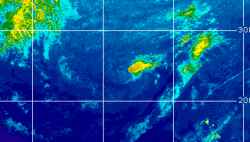
As of right now, we've got a fairly disorganized storm out there. Visible satellite imagery show multiple low-level circulations about an elongated trough oriented from NNE-SSW from west of Dry Tortugas to near Cancun and then paralleling the coastline toward Belize. Two of these circulations are evident outside of the convection, one near Cancun and another just to its north-northeast. There might also be a low-level center in the midst of the deep convection off of the coast of Belize. However, this convection is not as well organized as is that over western Cuba, where a mid-level circulation likely exists just north of the Isle of Youth.
In its current state of organization, what we've seen this morning will likely continue to occur. The mid-level circulation in the midst of the convection over Cuba will continue to spin-up small-scale low-level circulations that, as a result of the shear and the natural flow around the broader area of low pressure, continually get spit out into the netherlands of the NW Caribbean. Until that broad trough consolidates, strengthening is going to be limited. It's possible that either end of the feature becomes the dominant one -- those being the feature over Cuba and the feature near Belize -- but it's going to take time. I'll echo Rabbit's sentiments in that this isn't likely to be Alberto today. It might have the winds to be classified as a TS in the midst of that convection, but the state of organization will likely cause the NHC to be hesitant to upgrade it to a TS...particularly if a well-defined center cannot be found by recon.
Track thinking is largely unchanged from last night. Intensity thinking is also largely unchanged, but note that the primary impacts from this feature are going to be from rain rather than from wind unless some unexpected strengthening occurs. There is a shot that the depression can become a bit stronger than NHC forecasts if it accelerates toward the coast line (reducing the impacts of the shallower, cooler shelf waters plus weakening the storm-relative shear), but I still don't expect a hurricane out of this one.
The 12z model guidance is starting to come in as a suite now...here's a summary: * GFDL: minimal hurricane making landfall near Cedar Key, FL at early afternoon Monday * Canadian: strong TS/minimal hurricane making landfall near Apalachicola/St. George Island, FL lunchtime Monday * NOGAPS: very broad, weak cyclone making landfall near St. Marks, FL late Monday/early Tuesday. Evolution similar to TS Bonnie (2004). * UKMET: weak cyclone making landfall near St. Marks, FL sometime late Wednesday; very slow, erratic movement from Monday onward just off-shore. * FSU MM5: approaching the southern coast of central Louisiana early Thursday as a moderate tropical storm. * GFS: landfall as a weak-moderate tropical storm late Tuesday/early Wednesday near Cedar Key, FL. * NAM: landfall lunchtime Monday as a weak system near Buras, LA; remains in the vicinity of New Orleans for two days. Wouldn't put too much stock into it; the NAM isn't a great tropical model.
I'll let this all sink in for the afternoon for you all before coming back later today with a full forecast.
Forum Permissions
You cannot start new topics
You cannot reply to topics
HTML is disabled
UBBCode is disabled
Rating:
Thread views: 26342
Note: This is NOT an official page. It is run by weather hobbyists and should not be used as a replacement for official sources.
CFHC's main servers are currently located at Hostdime.com in Orlando, FL.
Image Server Network thanks to Mike Potts and Amazon Web Services. If you have static file hosting space that allows dns aliasing contact us to help out! Some Maps Provided by:
Great thanks to all who donated and everyone who uses the site as well.
Site designed for 800x600+ resolution
When in doubt, take the word of the National Hurricane Center