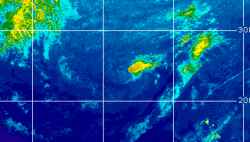
completely different situation than yesterday. for most of yesterday florida wasn't even in the 'cone' everybody always worries over... today it's the most prominent feature there behind perhaps cuba. this is one of those situations where subtleties of the track and the character of the storm make the intensity forecasts close to useless. we're going into a dennis/charley type situation here... something with elements of both, but with some potential key differences. ernesto appears to be a very small-core system. these can spin up and down very rapidly. ernesto is in a very similar position to where dennis was last year.. and dennis spun up to a very strong category 4 as it grazed into southern cuba. ernesto doesn't have nearly the organization or quite the upper environment dennis had, so while it may finally deepen (hasn't really since yesterday... 997mb is usually associated with a tropical storm) some before making landfall tomorrow morning, it probably won't be a major hurricane going in. it also looks to take a longer, more tortuous track over cuba than dennis did.. and after that the similarities with dennis may end. dennis did spin rapidly back up to a category 4 after leaving cuba, though.. as a note. the similarities with charley are that a trough will be stationed northwest of ernesto and recurve the storm... maybe over the peninsula of florida, maybe into north florida... maybe even across southeast florida. the storm will likely be a mid-range tropical storm leaving cuba with a disrupted core. a few hours over the florida straits may or may not allow it to reorganize, so if it goes right into south florida, don't expect much of a storm. if it tracks a bit further west, say into or west of the keys, and isn't hugging the sw florida coast.. it will be doing something like what charley did, and may be able to spin up substantially. a much weakened storm over cuba may actually be worse than a slightly weakened one, because the tendency to get further out in the gulf will be greater if the storm is weaker. just subtle factors in track here can make the difference between a tropical storm for florida, or a major hurricane. it is worth noting that the threat of a massive, large windfield hurricane that can smash hundreds of miles of coastal structures with surge is probably out of the question. the threat for a strong hurricane would be one with a tight, intense wind core that could inflict substantial structural damage close to the landfall point, and maybe a ways inland from there. something else a tad interesting is the threat of the storm slowing down, if the ridging doesn't decay as much as shown or the trough doesn't dig as much. the storm could potentially slow to a drift over the gulf in such scenario... not strongly represented by any model, but theoretically possible. it could also move very slowly over florida and cause flooding in places. the threat for a big hurricane hit on florida is fairly limited to the west central coast up to the big bend area. the panhandle, where i was thinking the other day... isn't totally out of the woods and if the storm were to come up there could be facing a mature and dangerous hurricane.. but right now it doesn't look like there will be enough ridging to take it there. places like georgia and the carolinas... the northeast part of florida... would maybe experience tropical storm conditions along the coastline... maybe a little stronger further up in the carolinas right near the coast if it were to move a little offshore and reintensify. lots of rain whether it does that or tracks inland... either way. elsewhere.. debby has just about signed off for 2006... the wave/low combo near 17/33 is well-defined with weak convection, but in a region of subsidence and marginal water that should prevent any development for another day or two. mild model support for it, and it already has plenty of latitude which should promote an early recurvature for anything that might form. eastpac looking to punch out another storm, so the atlantic may very well continue active in the coming week or two. HF 1637z27august
Forum Permissions
You cannot start new topics
You cannot reply to topics
HTML is disabled
UBBCode is disabled
Rating:
Thread views: 20561
Note: This is NOT an official page. It is run by weather hobbyists and should not be used as a replacement for official sources.
CFHC's main servers are currently located at Hostdime.com in Orlando, FL.
Image Server Network thanks to Mike Potts and Amazon Web Services. If you have static file hosting space that allows dns aliasing contact us to help out! Some Maps Provided by:
Great thanks to all who donated and everyone who uses the site as well.
Site designed for 800x600+ resolution
When in doubt, take the word of the National Hurricane Center