
 Local Weather Outlooks/Discussions (8)


SEASON PEAK IN ATLANTIC RECORD QUIET AS ANOTHER HURRICANE THREATENS HAWAII (LOWELL)
Posted: 12:50 PM 07 September 2026 | 8 Comments | Add Comment | Newest: 04:56 AM 08-Sep EDT
The Tropical Storm Watch for Oahu has been upgraded to a Warning as Lowell continues tracking substantially right of official forecast and model guidance and the odds that Hurricane Lowell leads to significant impacts across all of Hawaii are going way up. Efforts to protect life and property from flooding state-wide and wind in the west and also on higher elevations should be getting rushed to completion.
Ciel
Original Update
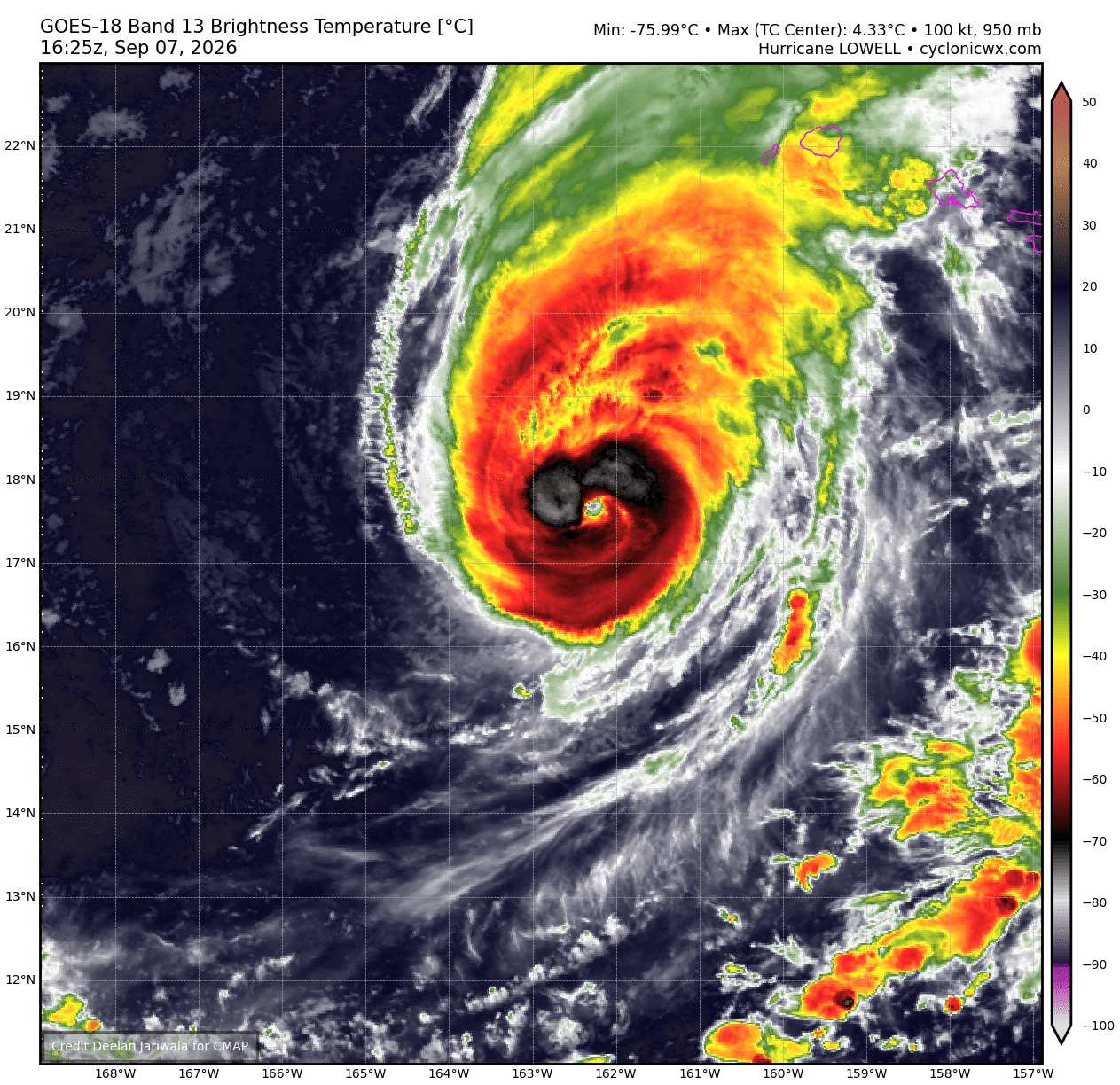
Above: Major Hurricane Lowell while tracking north-northeast towards Hawaii. Credits: Deelan Jariwala and cyclonicwx.com
With the exception of home-grown Edouard sneaking past many models to become a formidable tropical storm in the western Gulf, the Atlantic basin has otherwise been incredibly quiet so far during the heart of hurricane season. This is not the case in the Pacific with yet another hurricane heading towards the great state of Hawaii.
As of Sunday September 7, 2026 500 AM HST, Hurricane Lowell was located near 17.5N 162.6W, now tracking north-northeast around 14 mph. Hurricane Warnings are now up for Kauai County, including the islands of Kauai and Niihau and also the Papahanaumokuakea Marine National Monument from Nihoa to French Frigate Shoals. A Tropical Storm Watch has been issued for Oahu.
Lowell is a formidable hurricane and still a Major as of this update. The hurricane has been a Category 5 and despite 'weakening' in quotes, much of this energy does not rapidly go away with the decrease in category and interests in the hurricane warned portions of western Hawaii should begin rushing preparations to protect life and property to completion.
Lowell is producing impacts over a large area and the Big Island of Hawaii, even miles and miles away from the center, will likely experience flash flooding yet again. Some flooding has already begun from Lowell across the islands.
An additional 6 to 10 inches for Kauai, is forecast, locally 16 inches possible. For the Big Island, 4 to 8 inches of rain likely, locally up to 12 inches. Oahu and Maui counties can expect up to 8 inches, also locally higher.
We have Lounge two threads for Lowell ongoing in the Forums (Other Basins - General discussion) and a (Lounge - More modeling)
Dolly and Edouard
Posted: 04:08 PM 27 August 2026 | 14 Comments | Add Comment | Newest: 02:51 AM 03-Sep EDT
NHC has confirmed that Edouard has further intensified and is now making landfall as a 60 MPH 996 MB Tropical Storm. Additional strengthening is slightly possible, but not implicitly forecast. Once inland, given the small size of this cyclone, rapid weakening could commence within 12 hours.
Ciel
1:30PM CDT 1 September, 2026 Update
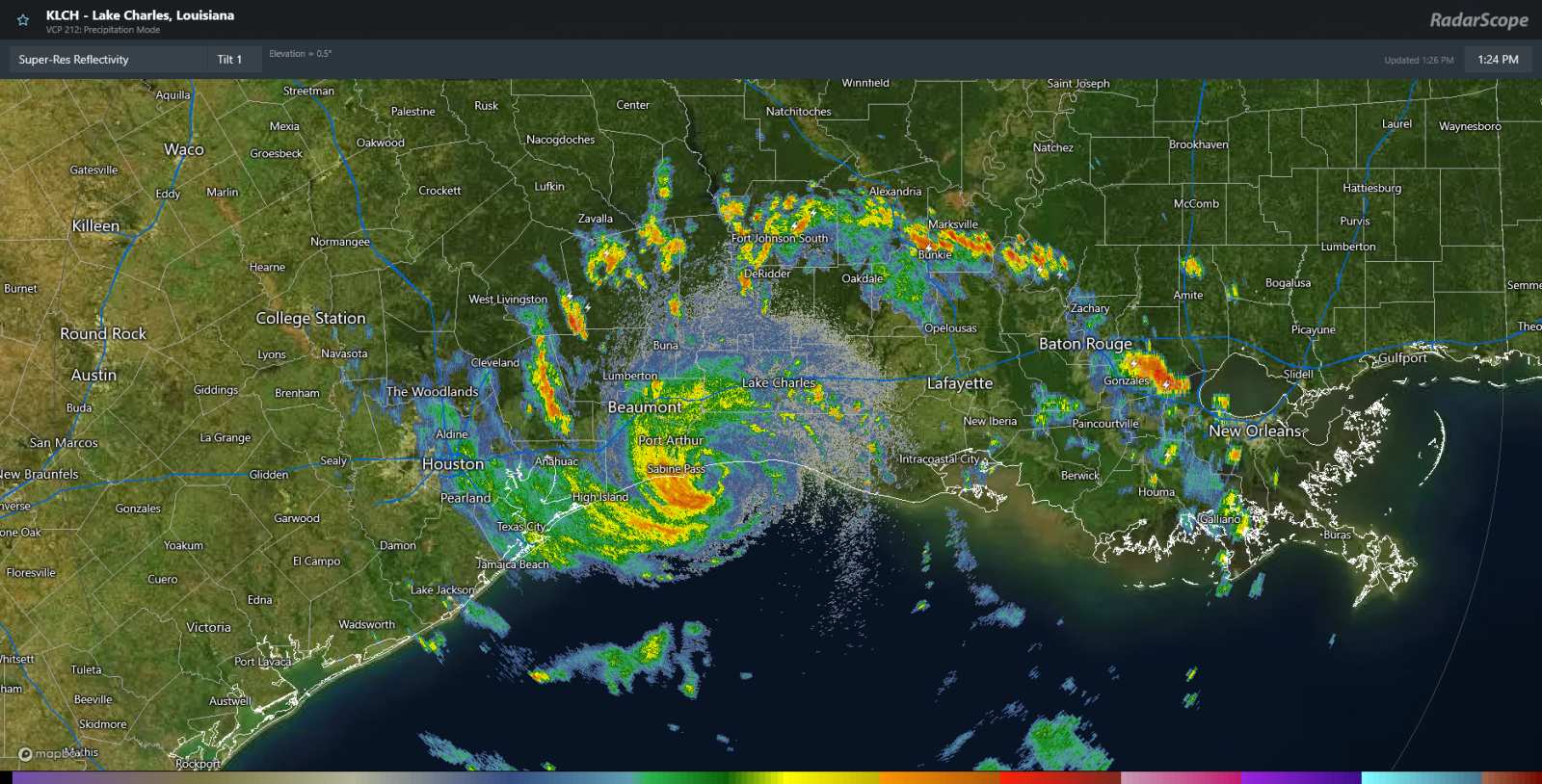
Edouard is making landfall in southwestern Louisiana as a mid-range 50+ MPH tropical storm. The cyclone does have radar returns that suggest winds could be at or near 60 heading into landfall, but awaiting NHC determination.
Compared to the other names we have had in the Atlantic basin this year, Edouard may be the best-looking. Certainly an A for effort.
CIel
7:30AM CDT 1 September, 2026 Update
A few changes.
For one, Edouard may be pushing inland a little bit north and a little earlier than was the forecast just last night. It may yet still slow down and/or bend a little west again however, so this is not certain. Nonetheless, locations closer to the TX/LA border may want to prep in case the core tracks much closer to this region than expected.
An earlier landfall could help cap its intensity. Most mets and weather geeks looking at this system take it right up to upper-end Tropical Storm, but Edouard becoming a hurricane is still very possible, and this is explicitly mentioned by NHC. In fact, Edouard has been building an eyewall since late last night. Hurricane Watches and Storm Surge Warnings are already in effect. Three to five feet of storm surge is forecast for locations between High Island, TX and the Vermilion/Iberia Parish line.
The cyclone is far wetter than it was yesterday, so having heavy rains cross a larger area is now more likely.
Ciel
2:00AM CDT 1 September, 2026 Update
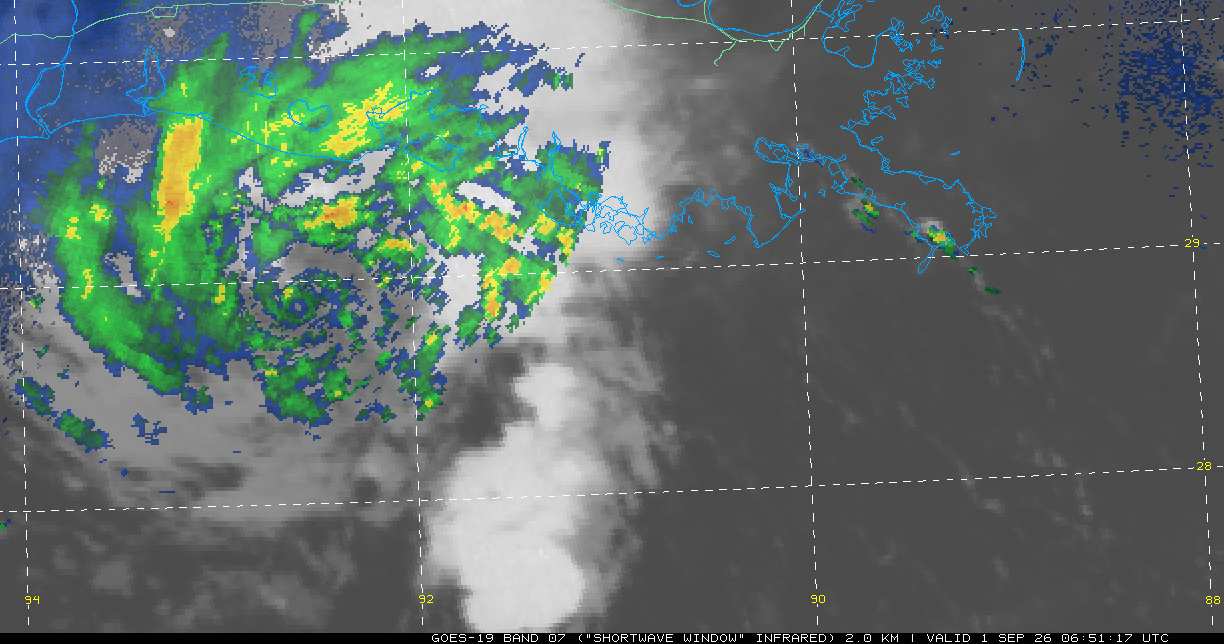
Banding and the incipient inner core continue improving overnight, and Edouard may be kicking off one of possibly two rounds of meaningful intensification prior to pushing inland.
Those along the upper Texas coast and southwestern Louisiana may want to pay closer attention and out of caution take some initial hurricane preps.
Ciel
10:30PM CDT 31 August, 2026 Update
A Hurricane Watch and Storm Surge Warning are up for portions of the NW Gulf coast.
SUMMARY OF WATCHES AND WARNINGS IN EFFECT:
A Storm Surge Warning is in effect for High Island to the Vermilion/Cameron Parish Line
A Hurricane Watch is in effect for High Island to the Cameron Louisiana
A Tropical Storm Warning is in effect for Port Bolivar to the Vermilion/Iberia Parish Line
Ciel
7:00PM CDT 31 August 2026, Update
FIVE has become Tropical Storm Edouard and conditions for further intensification heading towards landfall along the upper Texas coast and/or far southwestern Louisiana are in place.
Ciel
2:00PM ET 31 August, 2026 Update
FIVE has become a tropical cyclone and is now Tropical Depression FIVE (No longer 'Potential'). It was very close and many would argue that NHC could have just classified it a few hours ago, but there is no question now.
Winds to near tropical storm force have recently occurred in the more vigorous band on the south side of the center and FIVE is forecast to become Edouard later today or sometime tonight. As the center was pulled a little further east of its location yesterday in response to a blowup of convection on that side of the system, FIVE will probably now have even more time over the very warm gulf waters. Some model runs ramp it up quite a bit more than the official forecast and this is partly why.
Ciel
1:00PM ET 31 August, 2026 Update
Recon has found sufficient organization within Invest 97L for NHC to begin Advisories on PTC FIVE (Potential Tropical Cyclone). FIVE is expected to become Tropical Storm Edouard tonight and head towards the upper Texas coast.
Elsewhere, Invest Dolly has been decimated by shear while skirting the Greater Antilles. Regeneration odds now only NHC 10%.
Ciel
1:00PM ET 30 August, 2026 Update
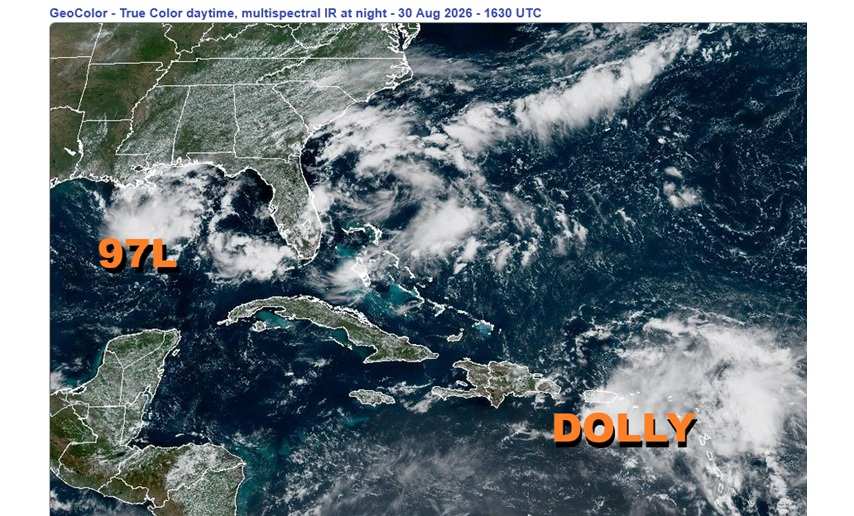
Some very real concerns during strong El Niño years is for waves to be held in check until they are coming much closer to land and also for fronts and/or trofs to linger over the Gulf and/or Gulf stream. We are now seeing these risks in action today as both Invest 97L and Invest Dolly are knocking on our door.
Interests in Louisiana and eastern Texas, perhaps especially the upper Texas coast, may want to begin paying close attention to Invest 97L. Conditions are becoming favorable for further development and a Tropical Depression or Storm could form within 48 hours.
Interests from the Bahamas to Cuba to South Florida may want to begin paying close attention to what we have been calling "Invest Dollly" (Former Tropical Storm Dolly). Conditions in the Gulf and Southwest Atlantic are becoming favorable for further development and a Tropical Depression or Storm could reform within 96 hours.
Ciel
9:30PM ET 29 August, 2026 Update
An area of low pressure that has formed south of Pensacola is presently in hostile conditions for development, but this may change as the system tracks west to west-northwest over the next few days, or at least until it runs into too much land. Considering how close to land Invest 97L already is, despite just 20% NHC odds, "Lemon Odds," we have also now opened up a Lounge for this Area of Interest: Invest FIVE Edouard Lounge
Ciel
11AM ET 28 August, 2026 Update
Dolly has opened back up into an open wave, even sooner than forecast, and the final NHC Advisory on short-lived Dolly has been written. This wave will continue to be monitored for potential regeneration later in the period, much like we monitor any Invest.
Ciel
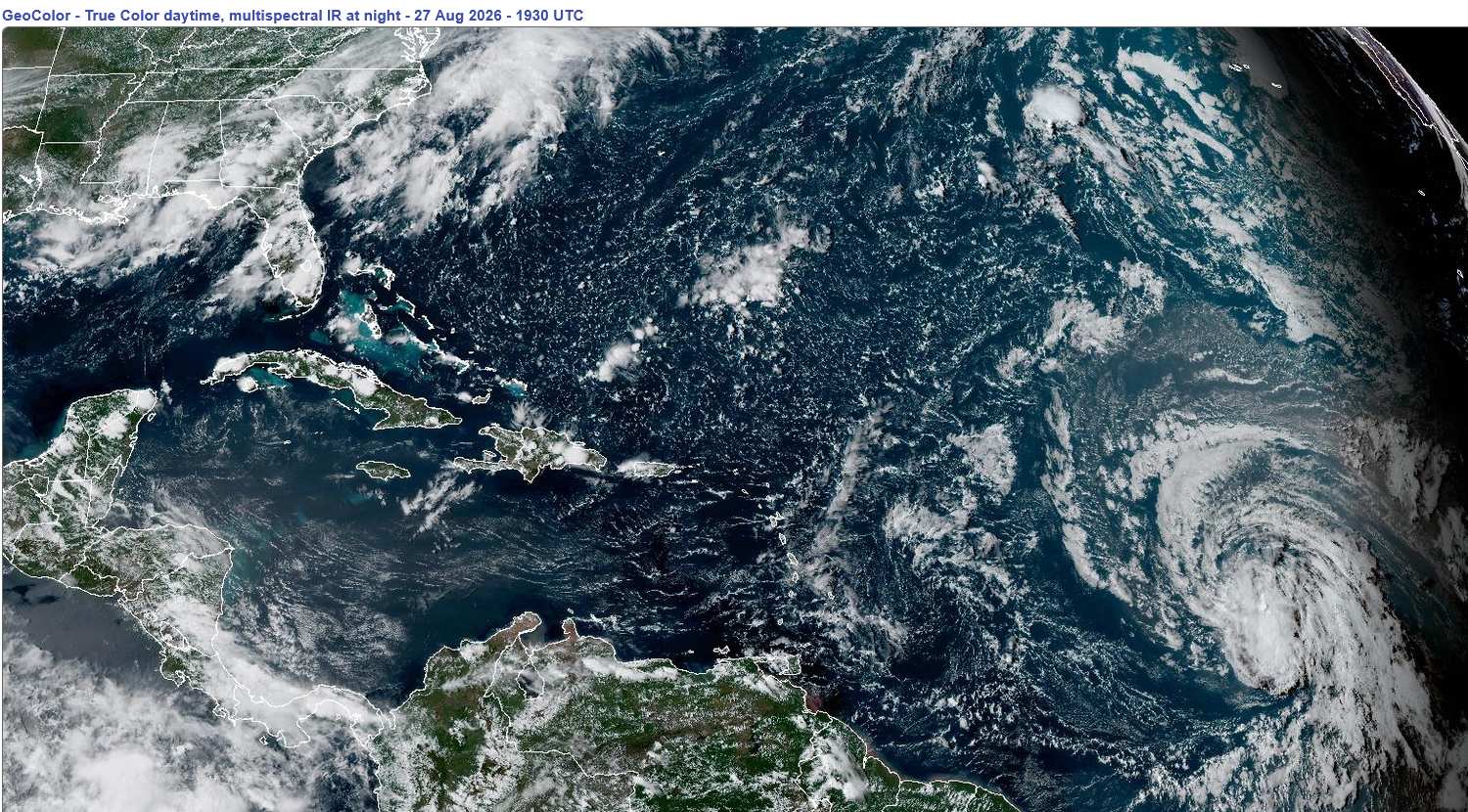
Lower Right: Tropical Storm Dolly in the Main Development Region of the Tropical Atlantic on August 27, 2026 1930z
Earlier today, Invest 96L became our first Cape Verde tropical cyclone of the year. Cape Verde tropical cyclone, for a strong El Niño, at any rate. It barely made it, but now Tropical Storm Dolly has formed.
Conditions for Dolly's future aren't looking especially promising, and nearly all models and indeed the official NHC forecast has Dolly opening back up to a stout wave within about 2 days. Some strong blustery wind and heavy showers would still more likely than not affect much of the Antilles, regardless, starting the coming weekend and into at least early next week. After that, a few models and ensembles are warm to regeneration closer to the United States, but this portion of the extended forecast is still very speculative (See Lounge for more on this).
Edouard Event Related Links
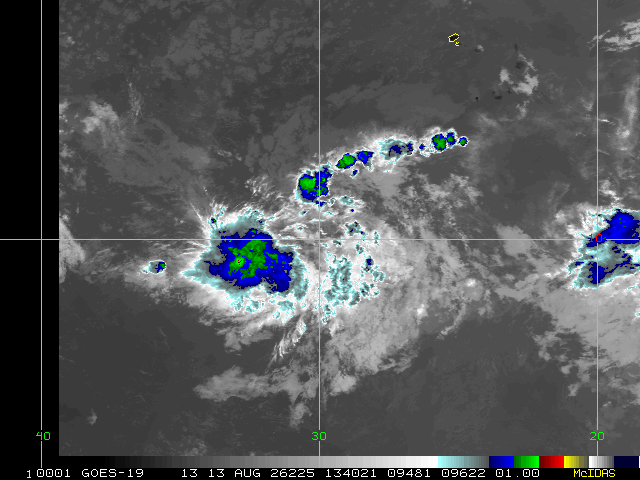
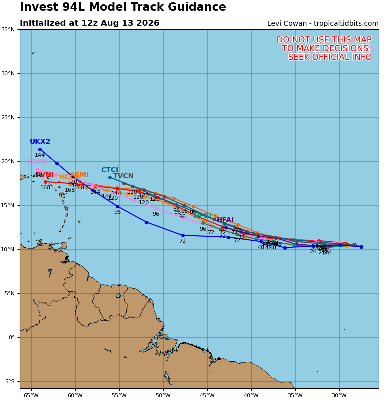
Tropical Tidbits Page on system
Flhurricane Satellite Floater Animation of Edouard
GOES Floater
Tomer Berg Info page for Edouard
CyclonicWx Page for Edouard
Clark Evans Track Model Plot of Edouard
(Animated!) Model Plots in Google Earth - In Google Maps
Clark Evans Intensity Model Plot of Edouard (Animated!)
Clark Evans Track Plot of Edouard
Clark Evans Top 10 Analog Storms for Edouard
http://www.ral.ucar.edu/guidance/realtime/current/ More model runs on from RAL/Jonathan Vigh's page
NRL Info on Edouard -- RAMMB Info
COD Atlantic Satellite View
Dolly Event Related Links
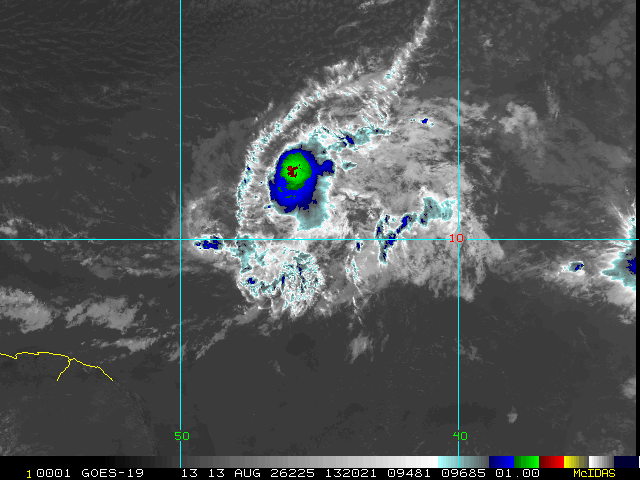
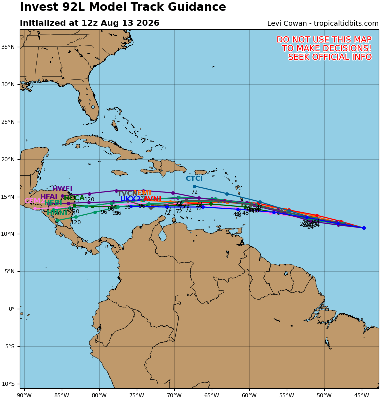
Tropical Tidbits Page on system
Flhurricane Satellite Floater Animation of Dolly
GOES Floater
Tomer Berg Info page for Dolly
CyclonicWx Page for Dolly
Clark Evans Track Model Plot of Dolly
(Animated!) Model Plots in Google Earth - In Google Maps
Clark Evans Intensity Model Plot of Dolly (Animated!)
Clark Evans Track Plot of Dolly
Clark Evans Top 10 Analog Storms for Dolly
http://www.ral.ucar.edu/guidance/realtime/current/ More model runs on from RAL/Jonathan Vigh's page
NRL Info on Dolly -- RAMMB Info
COD Atlantic Satellite View
StormCarib Reports from the Caribbean Islands
Caribbean Weather Observations
Full Caribbean Radar Composite
Caribbean Broadcast Corporation (TV/Radio from Antilles)
Central Pacific Hurricane Center
Radar:
South Shore Big Island, HI Radar Radar Loop
(Latest Static)
Kohala, HI (Big Island) Radar Radar Loop (Latest Static)
Molokai, HI (Maui/Oahu) Radar Radar Loop (Latest Static)
Kauai, HI Radar Radar Loop (Latest Static)
Hawaiian Media:
TV:
Hawaii News Now KGMB 9 (CBS)/KHNL 13 (NBC)
Newspaper:
Hawaii 24/7 (Big Island Newspaper)
Other:
Four Atlantic Slight Chance Areas in Late August as Tropical Storm Moke Threatens Hawaii
Posted: 10:57 PM 21 August 2026 | 2 Comments | Add Comment | Newest: 01:42 PM 23-Aug EDT
One of the very robust waves to exit Africa over the past week has overcome what has seemed near impossible this season to become a tropical storm, Dolly, in the Tropical Atlantic. While presently way, way out at sea, Dolly is worth monitoring for the extended range, as it may try to take advantage of possibly more favorable conditions closer to the Bahamas and/or the Gulf (Dolly has its own LOUNGE for these extended-range considerations)
Ciel
9AM ET (3AM HT) 22 August, 2026 Update
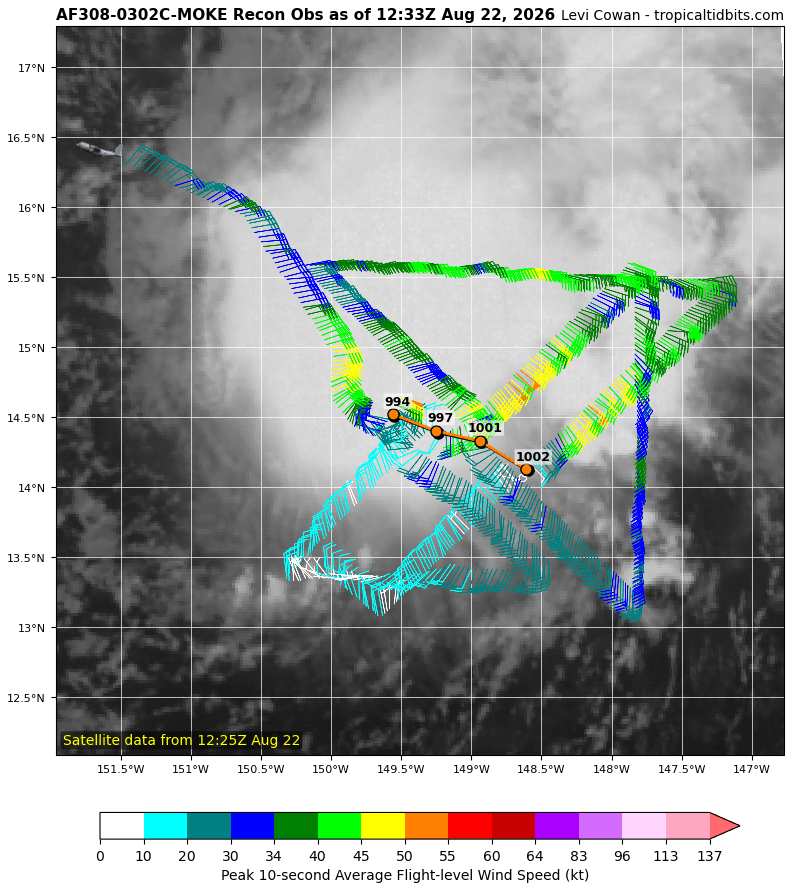
The final pass though from the third recon mission into Moke overnight found pressures had dropped within the cyclone to below 995mb, with winds possibly getting a little stronger. Almost all of the impactful weather from Moke is in its northern half because of shear. This also means that the heavy rain is being displaced to the north and will likely begin affecting the Hawaiian islands Saturday night and spread westward into early next week despite the storm center tracking well south of the islands. Winds across portions of the Big Island may reach tropical storm force, at least in gusts, but this will largely be due to a strong pressure gradient from interaction with the high pressure center to the north, and Tropical Storm Watches and Warnings are not expected. Additional flash flooding is a very real concern.
Ciel
Original Update
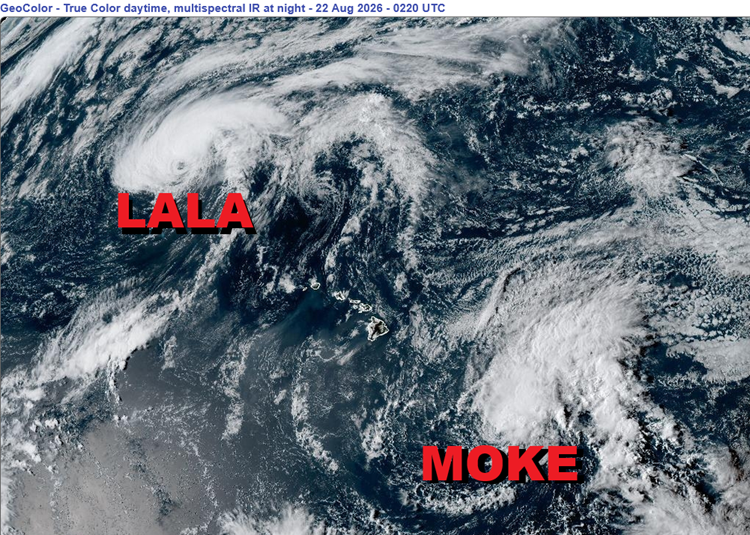
Three more Areas of Interest presently in the Atlantic have NHC odds of 20% or less for development, plus one that is yet to roll off Africa with also a 20% handle. Lots of lemons out there in the Atlantic basin during this record-setting El Niño.
First up is a wave, not yet mentioned in NHC's TWO, that has a slight model-suggested chance of becoming a short-lived TD or weak storm. This one is in the Main Development Region of the Tropical Atlantic, and is also the most tropical of the three currently in that basin. We are monitoring it in a Lounge, as it is a stout wave heading west, in the general direction of the Caribbean.
Second, a weak area of low pressure in the central subtropical Atlantic well east-southeast of Bermuda. This disturbance is expected to drift west-southwest over this weekend and then turn to the north next week, avoiding land.
Third, a non-tropical low in the far northeastern Atlantic, even beyond the Azores, has some tepid model support to acquire subtropical or tropical characteristics. It should ultimately bring wet and blustery weather to Spain and Portugal, though far less certain that it would have a name while doing so.
Next week, yet another stout wave rolling off Africa into the far eastern Atlantic is already NHC highlighted for a slight chance of development, at 20%.
Much closer to the United States is newly-named Tropical Storm Moke in the Central Pacific. This tropical cyclone has the potential to dump additional heavy rain on to the Big Island, still recovering from a direct hit from powerful Hurricane Lala just last weekend.
Dolly Event Related Links
Tropical Tidbits Page on system
Flhurricane Satellite Floater Animation of Dolly
GOES Floater
Tomer Berg Info page for Dolly
CyclonicWx Page for Dolly
Clark Evans Track Model Plot of Dolly
(Animated!) Model Plots in Google Earth - In Google Maps
Clark Evans Intensity Model Plot of Dolly (Animated!)
Clark Evans Track Plot of Dolly
Clark Evans Top 10 Analog Storms for Dolly
http://www.ral.ucar.edu/guidance/realtime/current/ More model runs on from RAL/Jonathan Vigh's page
NRL Info on Dolly -- RAMMB Info
COD Atlantic Satellite View
Central Pacific Hurricane Center
Radar:
South Shore Big Island, HI Radar Radar Loop
(Latest Static)
Kohala, HI (Big Island) Radar Radar Loop (Latest Static)
Molokai, HI (Maui/Oahu) Radar Radar Loop (Latest Static)
Kauai, HI Radar Radar Loop (Latest Static)
Hawaiian Media:
TV:
Hawaii News Now KGMB 9 (CBS)/KHNL 13 (NBC)
Newspaper:
Hawaii 24/7 (Big Island Newspaper)
Other:

Three Atlantic Areas Mid-August Blew Tires. Hurricane Lala Hits Hawaii.
Posted: 07:13 AM 10 August 2026 | 4 Comments | Add Comment | Newest: 01:20 AM 16-Aug EDT
Lala has become a hurricane and is also now seemingly pulling a bit right (north) of prior track, as many of the more bullish hurricane models expected. This will bring more of the most dangerous weather to the Big Island for many hours to come, and preparations to protect life and property should already be completed, ideally.
Ciel
1PM ET (7AM HT) 15 August, 2026 Update
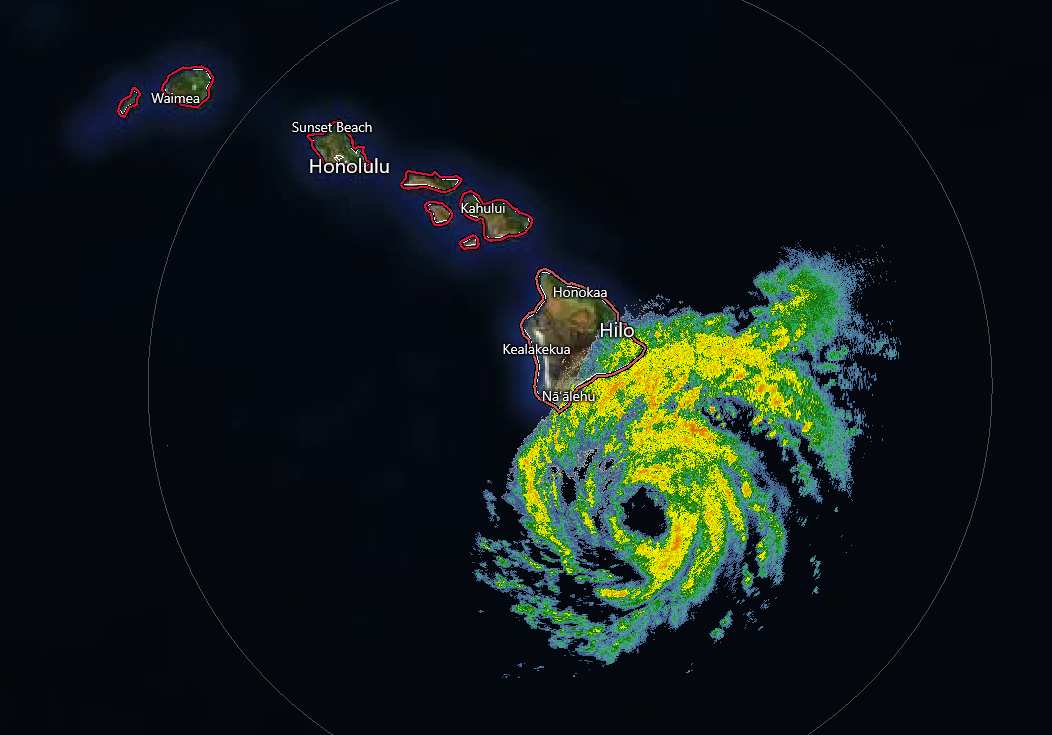
Recon has left Hawaii, following protocol given safety and logistic considerations. However, based on radar, satellite and microwave analysis, Lala will likely soon be a hurricane, already with a ragged eye apparent.
Track has been a little left (south) of forecast and many models (esp the hurricane models). A track that avoids landfall could preclude history books, but actually lessen the possible disruption of the center tracking over the very high mountains of the Big Island.
Regardless of exact track, this is a very dangerous tropical cyclone that will undoubtedly dump tons of rain resulting in flooding and mudslides. Preps to protect life and property should be rushed to completion.
Ciel
1:30PM ET 14 August, 2026 Update
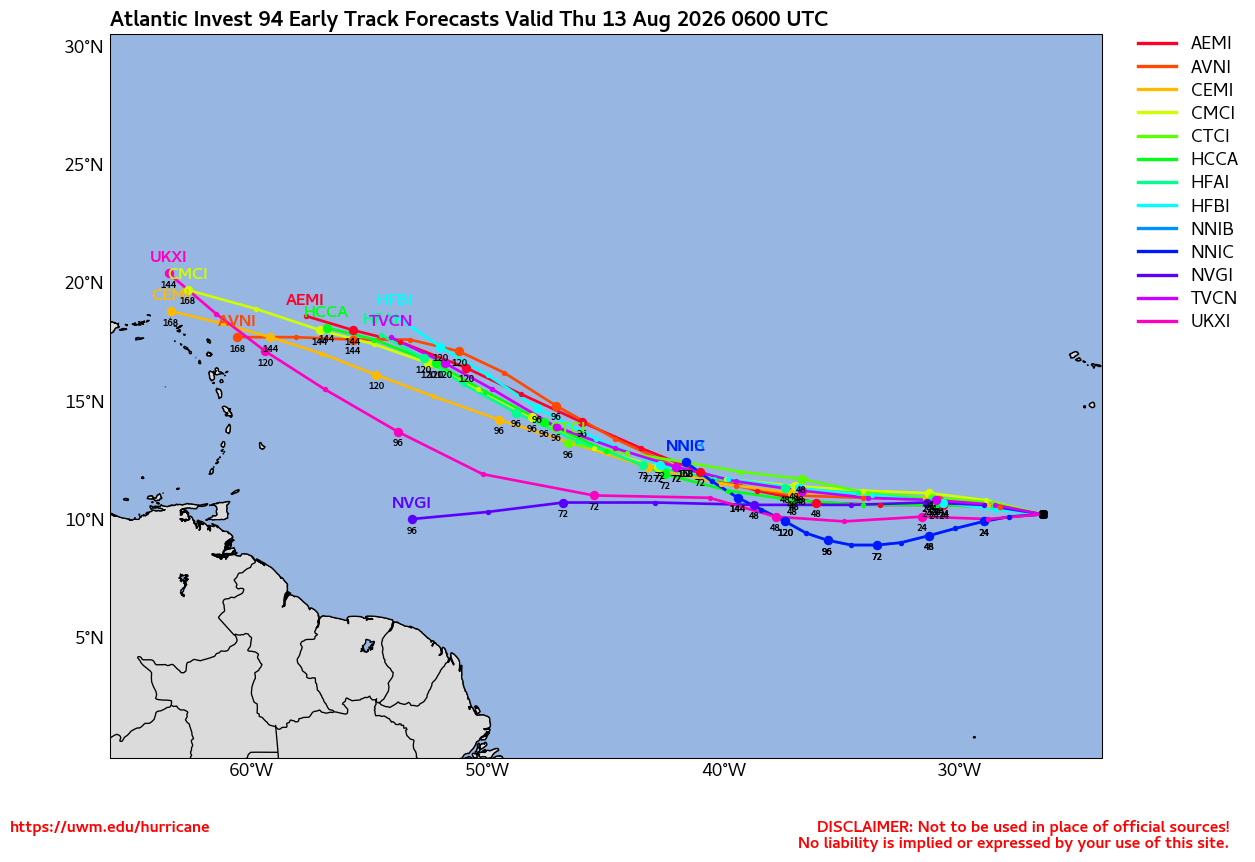
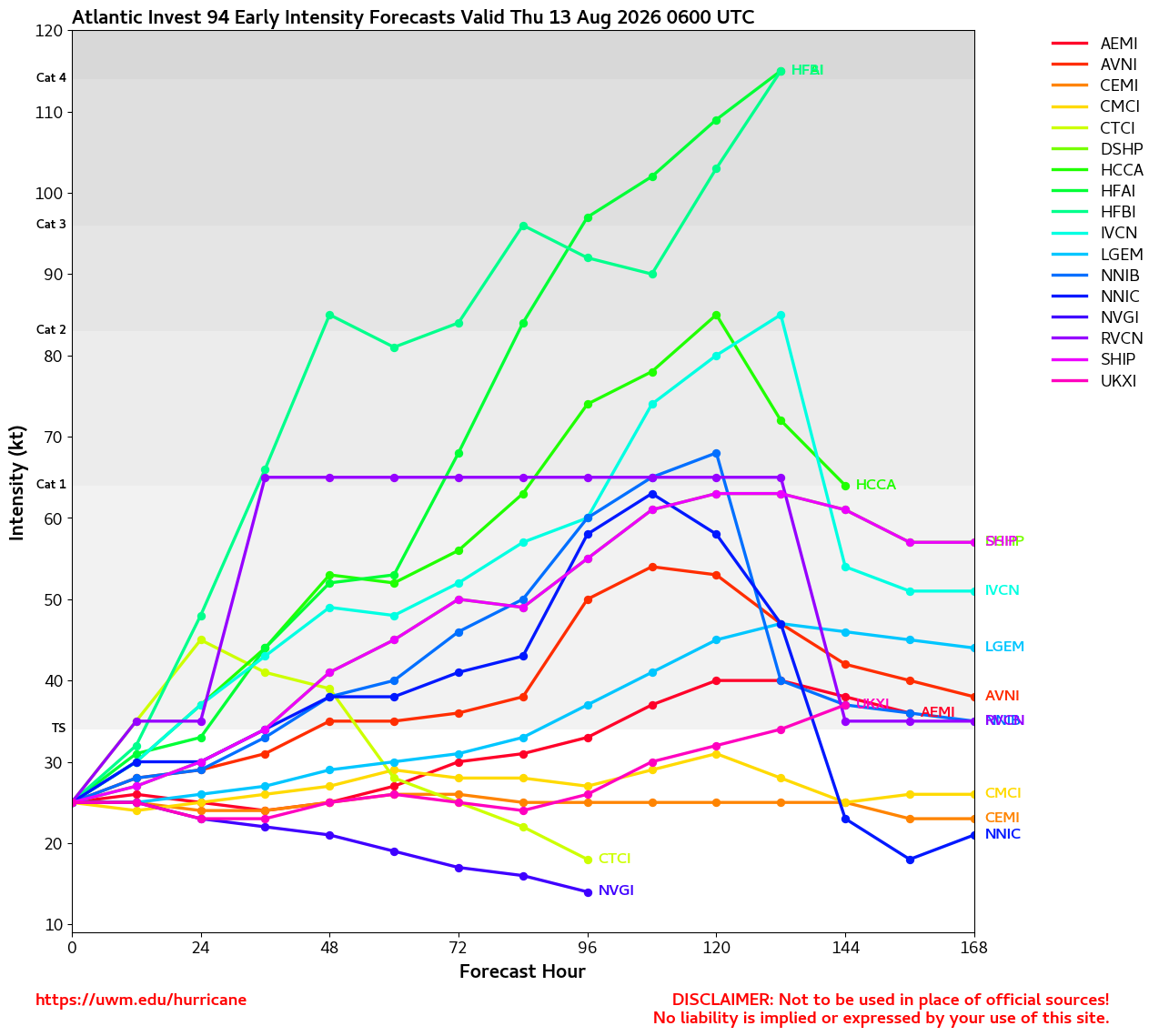
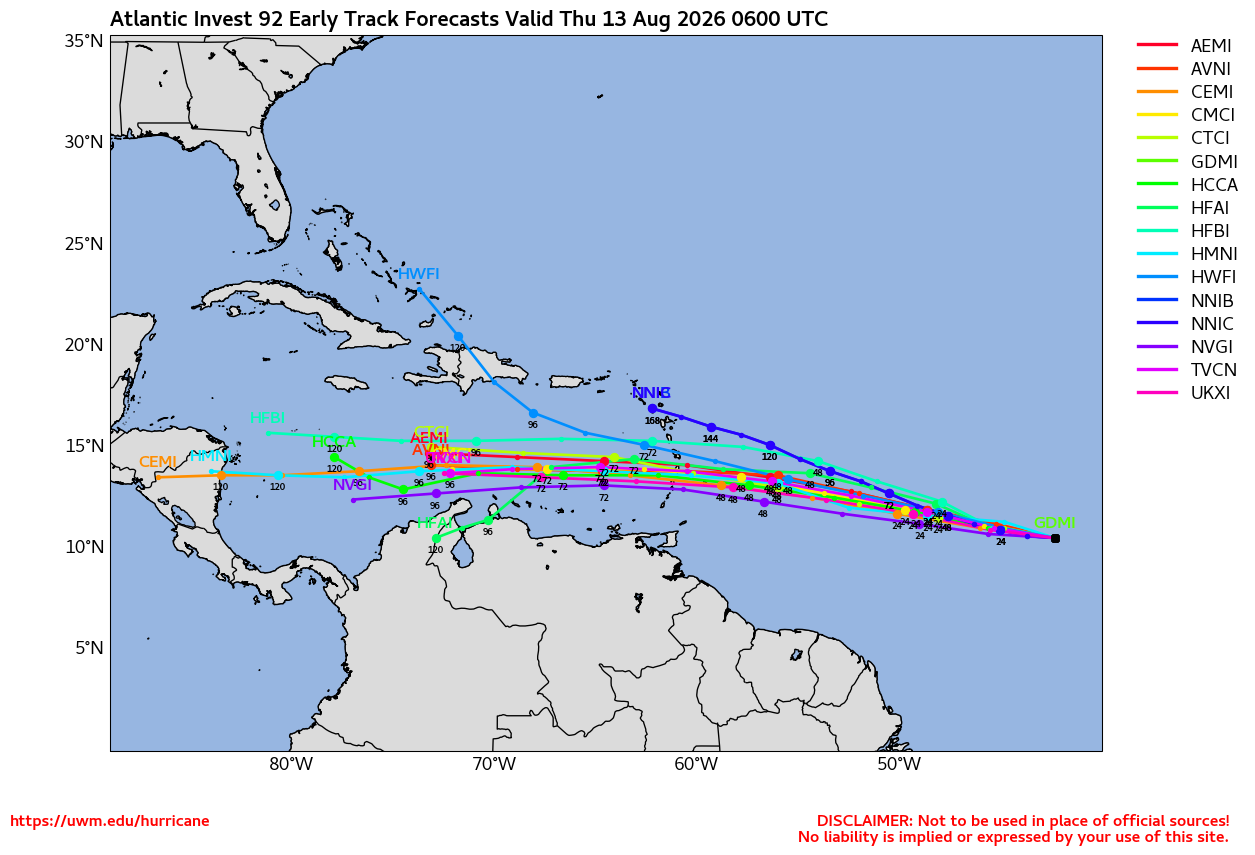
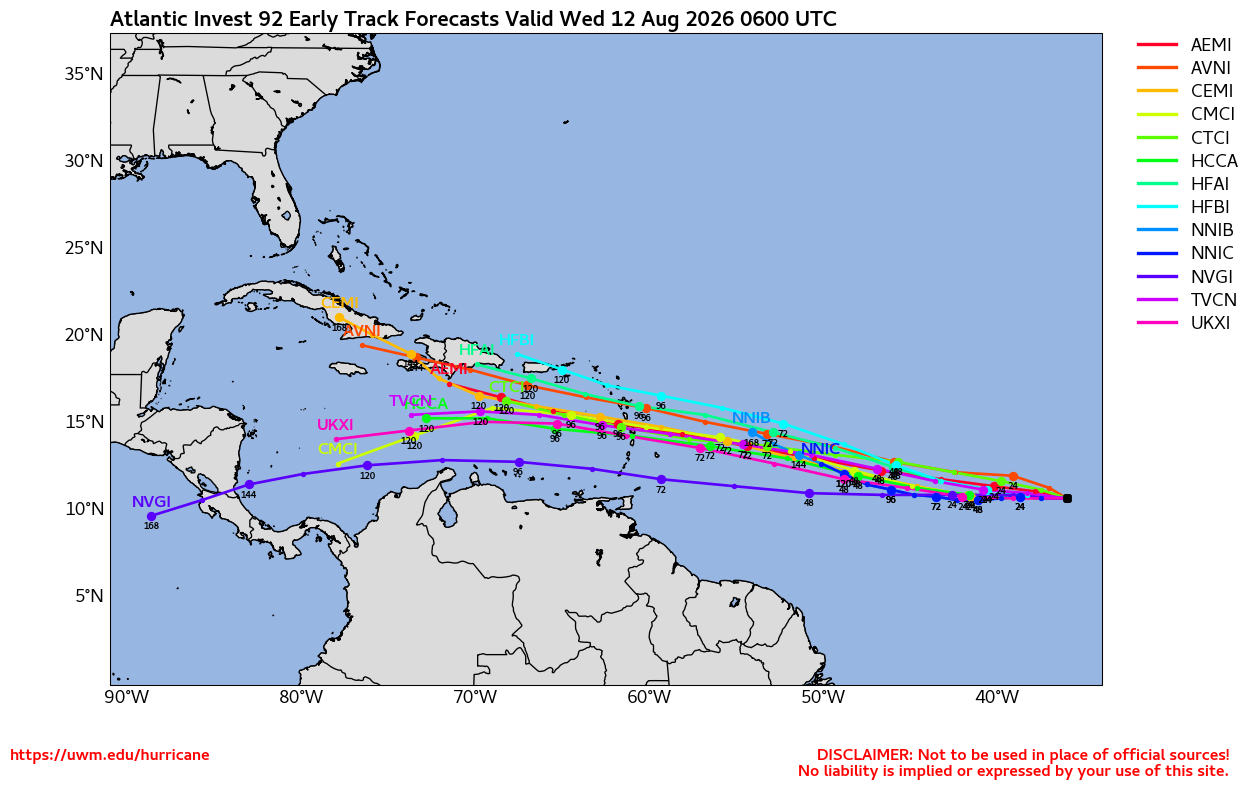
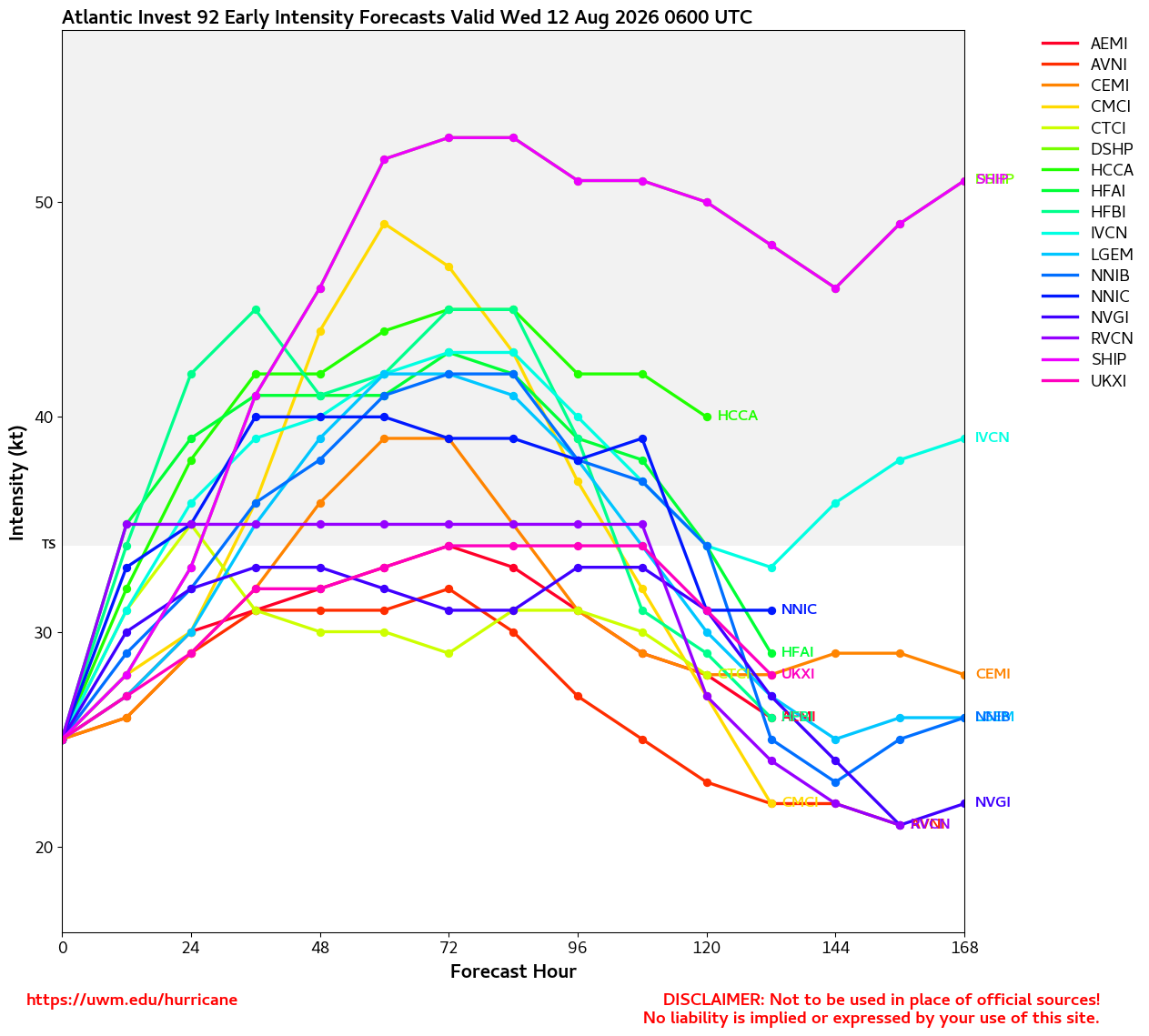
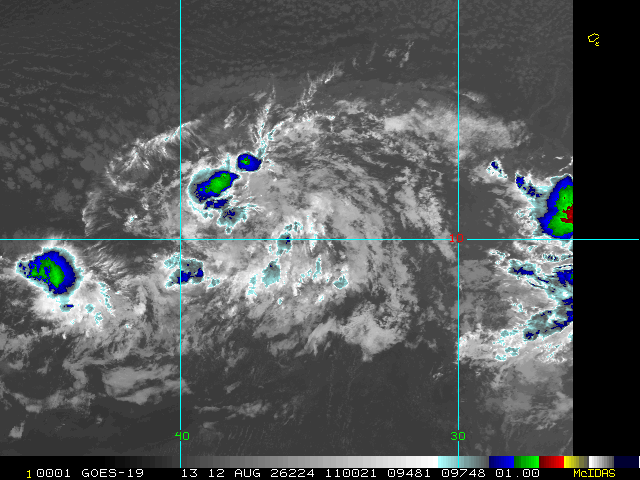
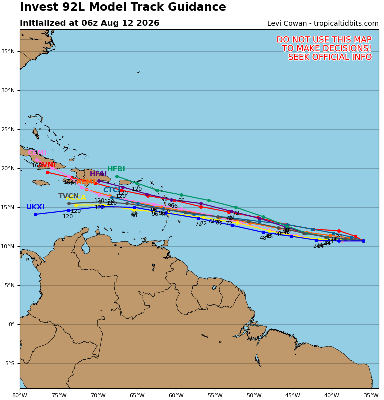
In the Main Development Region of the Atlantic basin, Invest 92L is approaching the Lesser Antilles today with a large area of showers and thunderstorms. Development odds per NHC have dropped dramatically, now just 20%. Nonetheless, some pockets of heavy rain and winds up to 30-40 MPH in spots seems likely. Maybe not the best beach day. Behind 92L, 94L continues to have better model support for development potential and NHC still assigns it a coin-flip shot of development within the next 7 days. All in all, this historic and record-setting El Niño has drastically hampered attempts of development and/or strengthening in the Atlantic.
On the other side of the CONUS, Hawaii is facing a significant threat of serious impacts from Tropical Storm Lala, which is forecast to be at or near hurricane intensity during passage very near or directly over the Big Island. Preparations on the Big Island to protect life and property should be rushed to completion today. Life-threatening flooding, mudslides, winds, surge and waves are likely over the weekend.
Ciel
11:30AM ET 13, August, 2026 Update
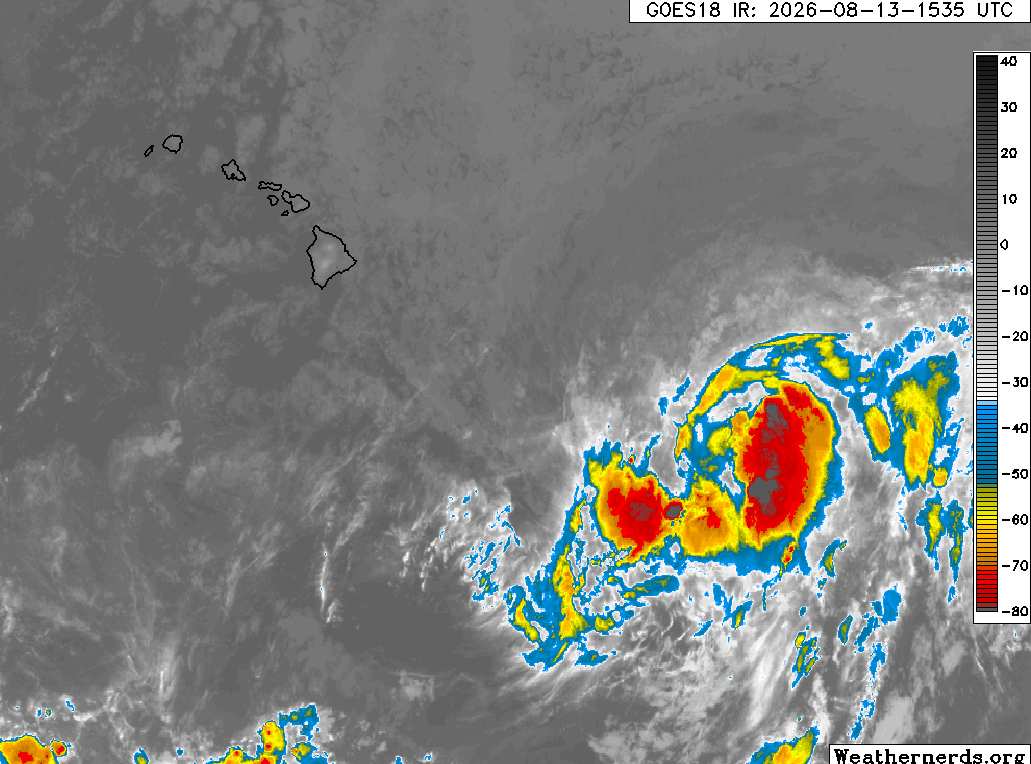
Above: Tropical Storm Lala on approach to Hawaii. Image credit: Weathernerds.org
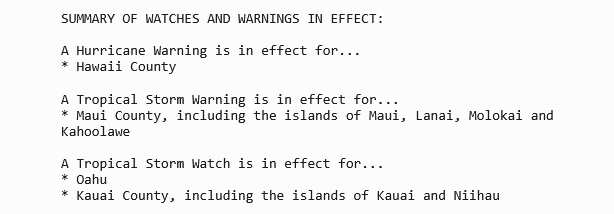
A Hurricane Watch has been issued for the Big Island of Hawaii. Now Tropical Storm Lala is forecast to be at or near hurricane strength as it crosses the Hawaiian island. Very heavy rain will begin to impact the Big Island tomorrow, Friday, and spread throughout the chain over the weekend, resulting in potentially life-threatening flooding and mudslides.We have a Forecast Lounge up for Lala.
Elsewhere, the Atlantic basin is less than favorable for development and seeming to trend more and more inhospitable by the day. Invests 92L and 94L struggle in the Main Development Region and it is nowhere near certain that either one gets named.
Ciel
2:30AM ET 13, August, 2026 Update
Very challenging conditions for development abound throughout the Atlantic basin. The northernmost feature, a subtropical trof that broke off to the northeast, actually picked up the name Cristobal, and might be the saddest looking tropical storm of the year so far. But, there's still time for a challenger to take that title away. Invests 92L and 94L are trying.
92L has been a borderline TD for at least a half a day now. One could understand if NHC went ahead and numbered it. Models keep backing down on its potential, most now never strengthening it beyond a low-end tropical storm or depression.
94L is not especially organized still, despite occasionally sporting beefier convection than either 92L or Cristobal. Fewer ensemble models seem to want to develop this one now, also.
In the central Pacific, all eyes are on Storm One-C, still a "Potential Tropical Cyclone," but one that is already producing winds of tropical storm force. The expectation is that its elongated circulation with presently two vorticity maxima comes together as one and intensifies as it heads towards Hawaii, but this is still a little uncertain. Nonetheless, interests in Hawaii may want to begin paying very close attention, as even if One-C does not organize much more (low chance, but possible), heavy, flooding rains and strong winds will still be likely.
Ciel
Original Update
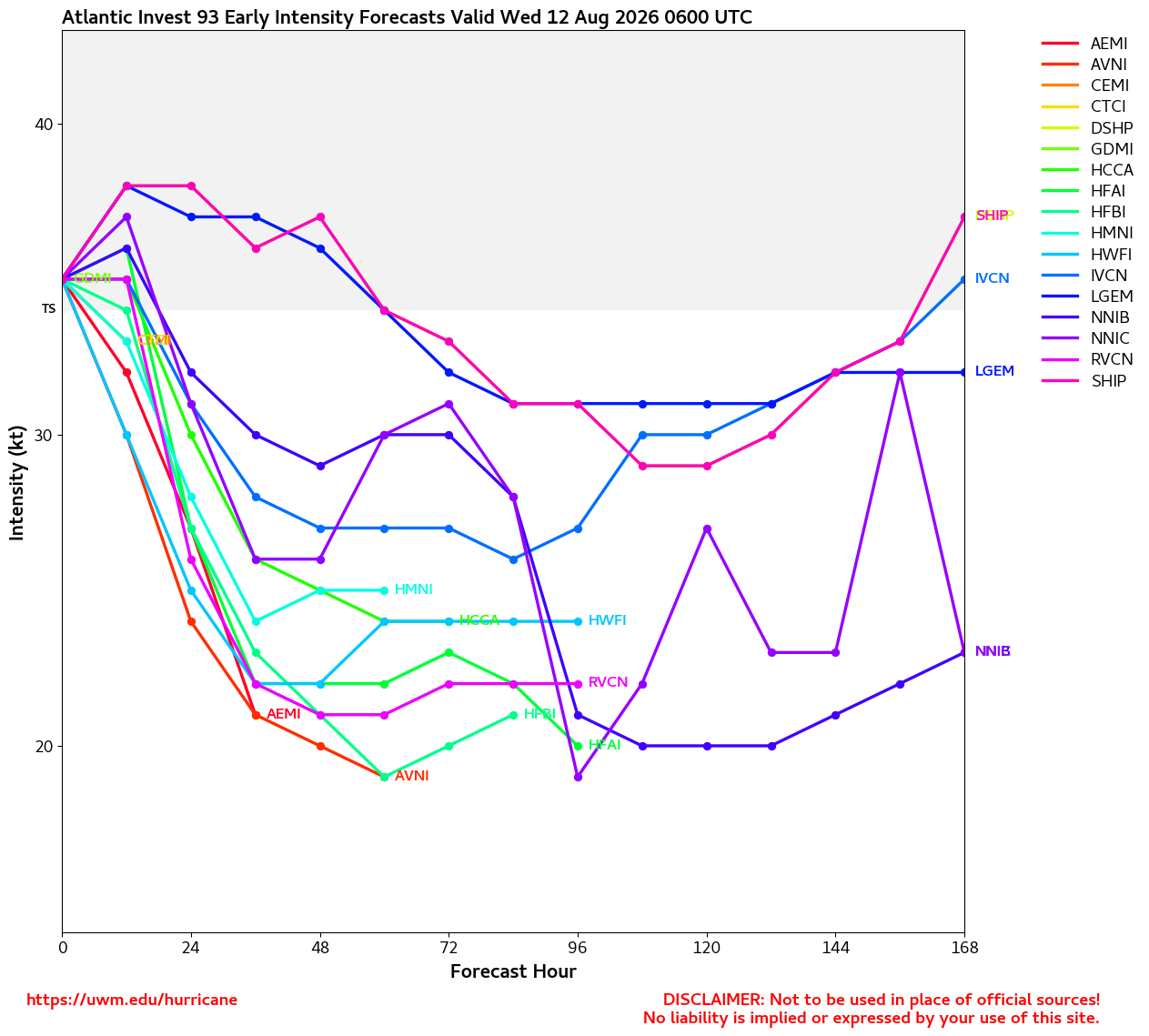
The Atlantic has three areas of interest this morning. The first area is new, the northern one, quickly moving east. It could develop into a short live system before it hits cooler waters. This has a 10% chance according to the National Hurricane Center.
The second area is the leading wave in the Central Atlantic is heading west with a 10% chance also, this one is less likely to develop and if it does likely to hit shear from the TUTT ahead of it keeping it from developing, those in the Caribbean will want to watch it still however for around Thursday.
The last area is east of there, south of the Cape Verde islands, with a 60% chance to develop, this one is likely the most prime candidate to develop, however, none of them have been invest tagged yet (this one may get tagged later today or tomorrow). It could be the one that slips through the shear, however more likely to miss the islands to the north. But those in the Caribbean still should watch this coming weekend to Monday if this system is weaker than expected. Bermuda also may want to watch much later for mid to late next week as it could get close. That's currently the most likely scenario right now, but it could change. Watch here or the lounge on flhurricane for a bit more speculation. Lounge thread https://flhurricane.com/cyclone/showflat...;vc=#Post116098 The general high shear environment of el nino is still there, and this system is likely to struggle to develop.
In the Central Pacific, invest CP93 has a 90% chance, and Hawaii should watch closely.
Invest 92L Event Related Links
Tropical Tidbits Page on system
Flhurricane Satellite Floater Animation of 92L
GOES Floater
Tomer Berg Info page for 92L
CyclonicWx Page for 92L
Clark Evans Track Model Plot of 92L
(Animated!) Model Plots in Google Earth - In Google Maps
Clark Evans Intensity Model Plot of 92L (Animated!)
Clark Evans Top 10 Analog Storms for 92L
http://www.ral.ucar.edu/guidance/realtime/current/ More model runs on from RAL/Jonathan Vigh's page
NRL Info on 92L -- RAMMB Info
COD Atlantic Satellite View
Cristobal Event Related Links
Tropical Tidbits Page on system
Flhurricane Satellite Floater Animation of Cristobal
GOES Floater
Tomer Berg Info page for Cristobal
CyclonicWx Page for Cristobal
Clark Evans Track Model Plot of Cristobal
(Animated!) Model Plots in Google Earth - In Google Maps
Clark Evans Intensity Model Plot of Cristobal (Animated!)
Clark Evans Track Plot of Cristobal
Clark Evans Top 10 Analog Storms for Cristobal
http://www.ral.ucar.edu/guidance/realtime/current/ More model runs on from RAL/Jonathan Vigh's page
NRL Info on Cristobal -- RAMMB Info
COD Atlantic Satellite View
Invest 94L Event Related Links
Tropical Tidbits Page on system
Flhurricane Satellite Floater Animation of 94L
GOES Floater
Tomer Berg Info page for 94L
CyclonicWx Page for 94L
Clark Evans Track Model Plot of 94L
(Animated!) Model Plots in Google Earth - In Google Maps
Clark Evans Intensity Model Plot of 94L (Animated!)
Clark Evans Top 10 Analog Storms for 94L
http://www.ral.ucar.edu/guidance/realtime/current/ More model runs on from RAL/Jonathan Vigh's page
NRL Info on 94L -- RAMMB Info
COD Atlantic Satellite View
StormCarib Reports from the Caribbean Islands
Caribbean Weather Observations
Full Caribbean Radar Composite
Caribbean Broadcast Corporation (TV/Radio from Antilles)
Central Pacific Hurricane Center
Radar:
South Shore Big Island, HI Radar Radar Loop
(Latest Static)
Kohala, HI (Big Island) Radar Radar Loop (Latest Static)
Molokai, HI (Maui/Oahu) Radar Radar Loop (Latest Static)
Kauai, HI Radar Radar Loop (Latest Static)
Hawaiian Media:
TV:
Hawaii News Now KGMB 9 (CBS)/KHNL 13 (NBC)
Newspaper:
Hawaii 24/7 (Big Island Newspaper)
Other:
Ending July with the Atlantic Quieter, Pacific Roaring
Posted: 02:43 PM 26 July 2026 | | Add Comment
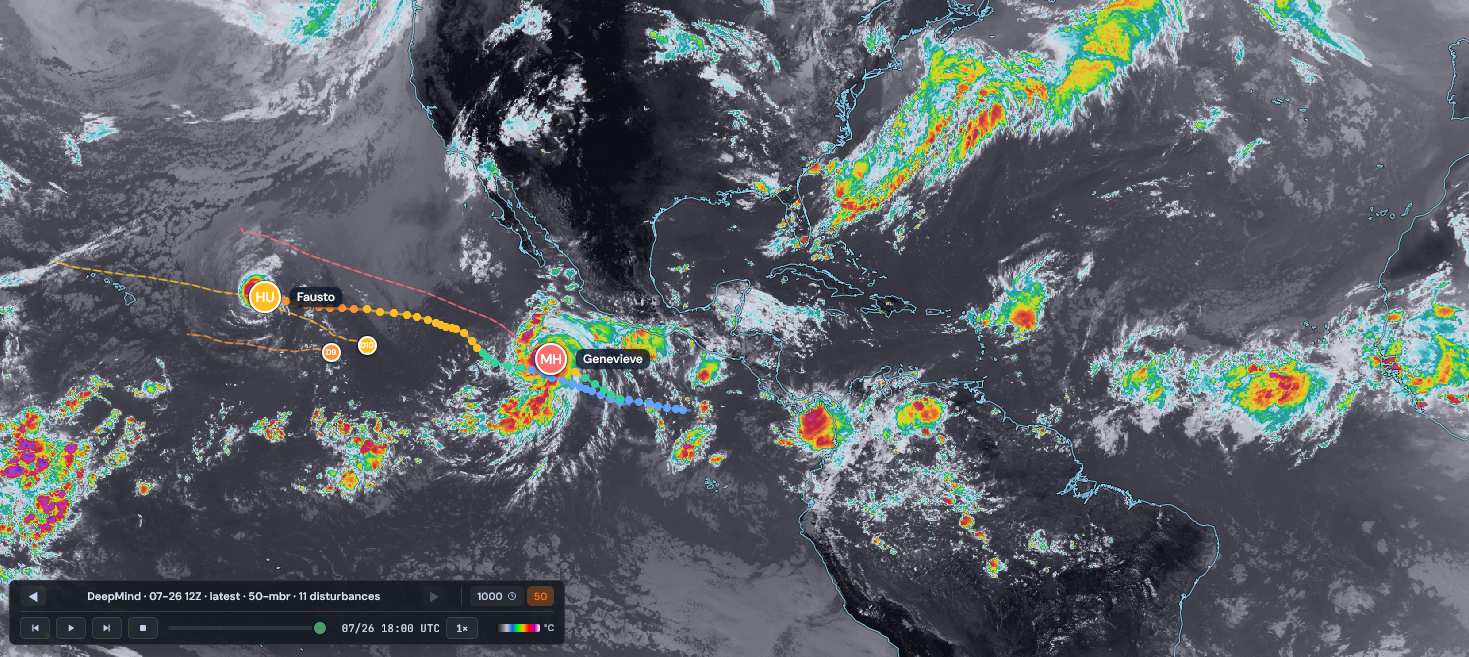
Screenshot image credit: TC-ATLAS
What is becoming quite possibly one of the strongest, if not the strongest, El Niños on record,has made it very difficult for otherwise could-be very powerful tropical cyclones in the Atlantic to level up. Both Arthur and Bertha had internal dynamics that in even just average ENSO years could easily have had them both become formidable early season hurricanes, instead came in much less intense versions of themselves. In the Pacific, things are completely different, and a number of US land locations on that side of the CONUS look to be at greater risk for impacts and maybe even direct hits this year.
We are currently tracking Hurricane Fausto, which is likely to at least indirectly swipe the northern Hawaiian islands and bring enhanced, potentially flooding rainfalls to some locations there. We have a Lounge up on this system and have allowed our Hype Scale to reflect the possibility of a US land impact for it, although this number could be coming down if current north-side-of-cone tracks continue. Recon is flying multiple flights into Fausto and this information is truly helping to improve the forecast.
Getting back to the Atlantic as we head into August, even strong El Niño years can occasionally see substantial rampups during that roughly August 20 to Sep 10 lead into climatological peak, so things may pick up later in August. Near-term, both the MJO and NAO phases are actually supportive for development in the Atlantic basin, but Chris Farley would like to have a word with them.
 Re: Long Range 2026Stable air in the Atlantic continues to be the name of the game. 30% area is unlikely to get going, and it's getting more likely that September will end without a named storm. Although east pacific remains active, mor...
- Re: Long Range 2026Today is September 10th, historically the peak of hurricane season, and nothing in the Atlantic right now. Modeling is sparse except for a likely faux Venezuela feedback storm (classic quirk of the current version of ...
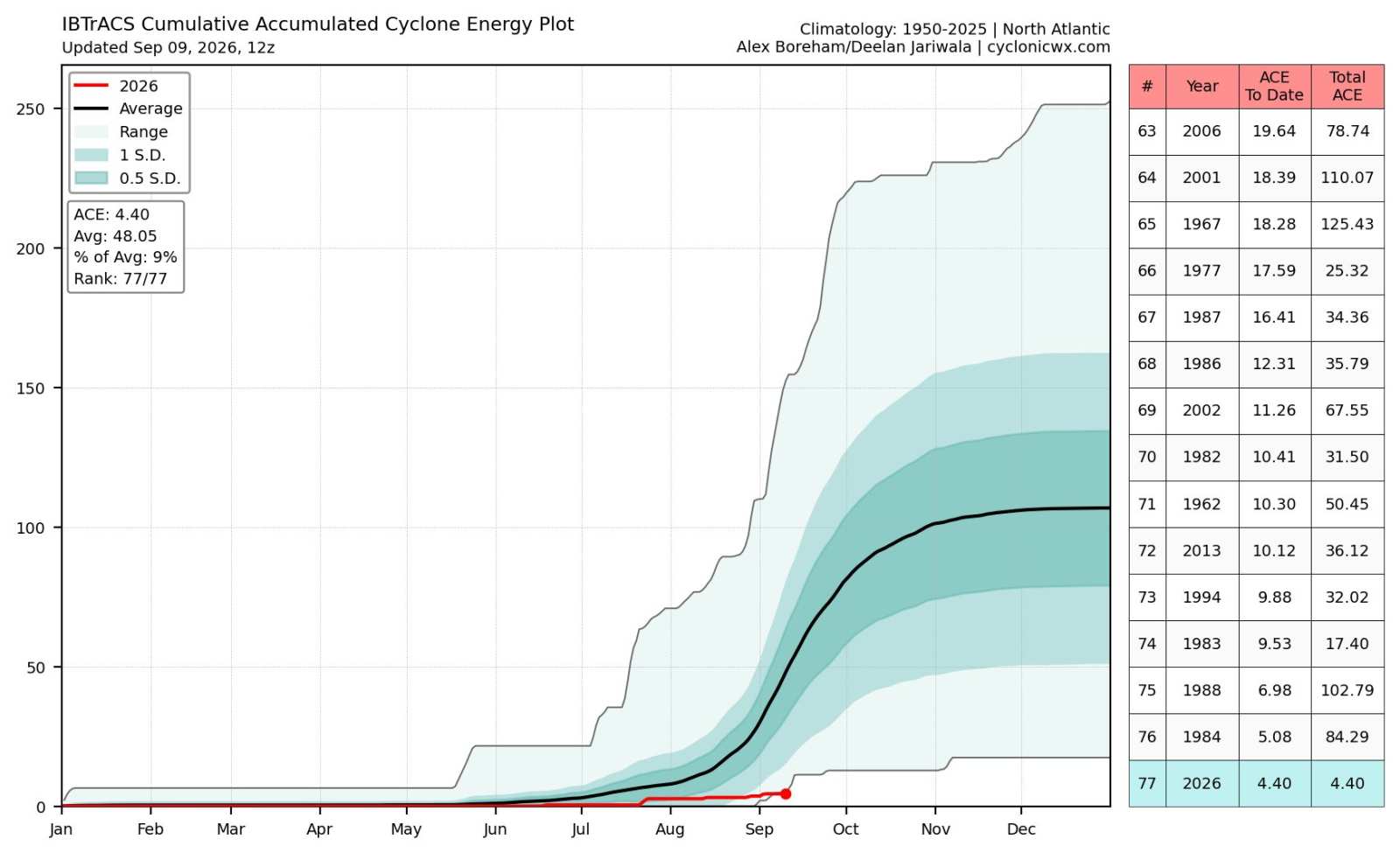 Re: Long Range 2026I'm pretty sure this isn't what those calling for an above average Atlantic season this year had in mind for an ACE in the hole
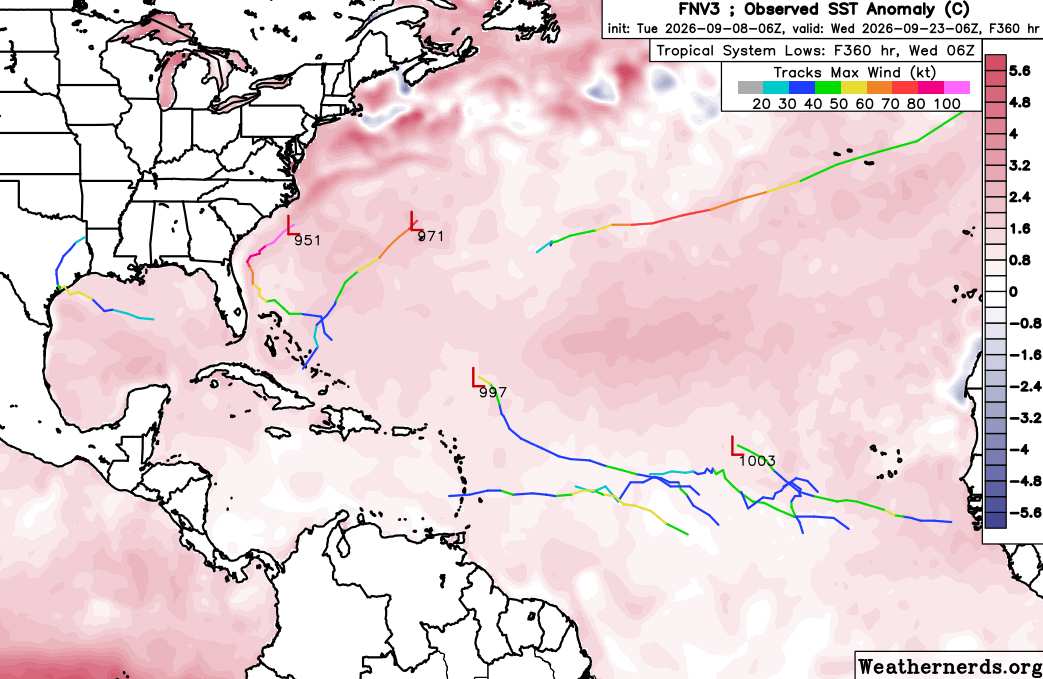 Re: Long Range 2026A good seasonal model this year could be created using insects. The Atlantic is crickets. The next two weeks out (360 hours from time stamp initialization) from both the DeepMind and EURO AI ensembles imply a roughly ...
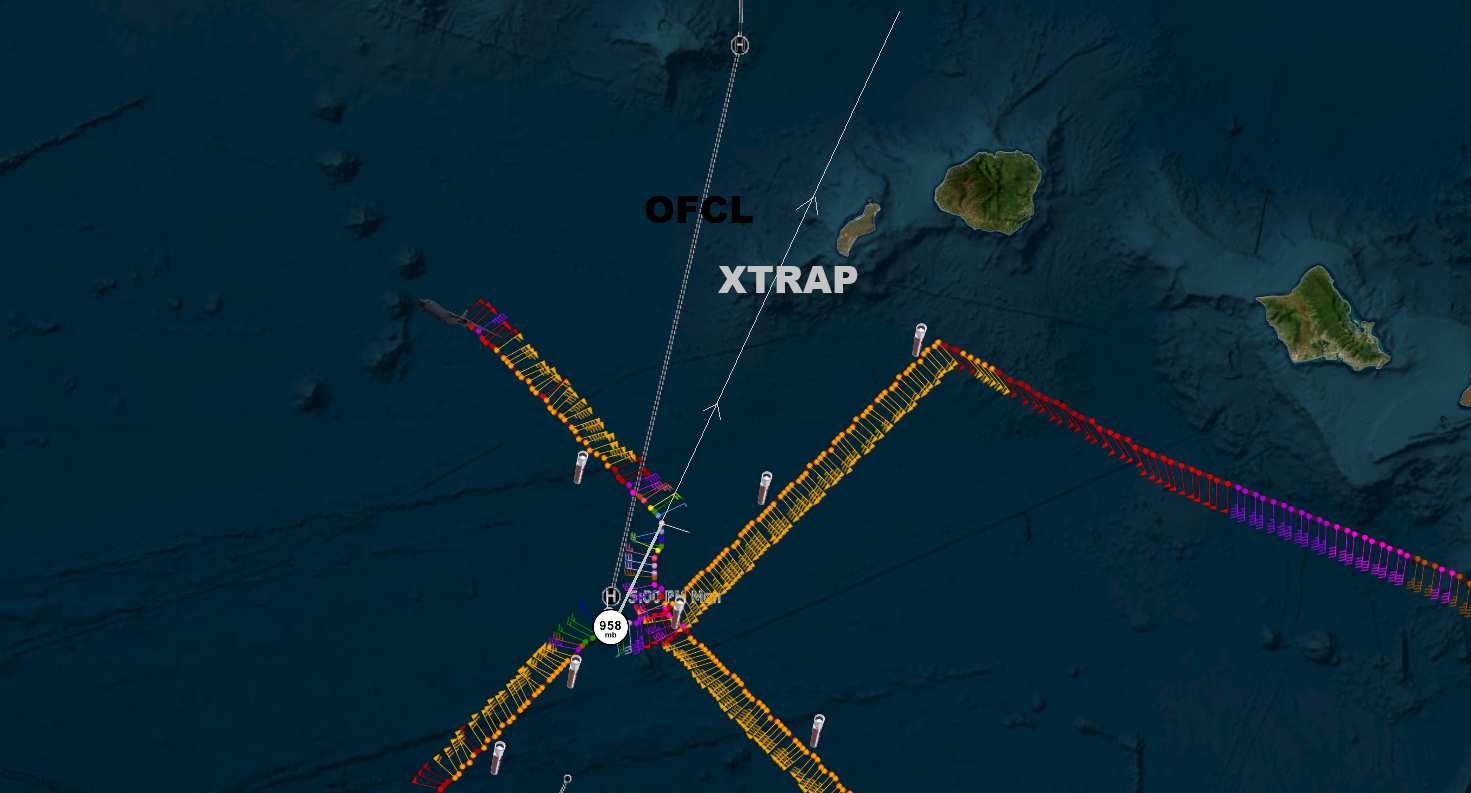 Re: Lowell Forecast Lounge: Hawaii ThreatLowell may still be trending right of forecast ('OFCL')
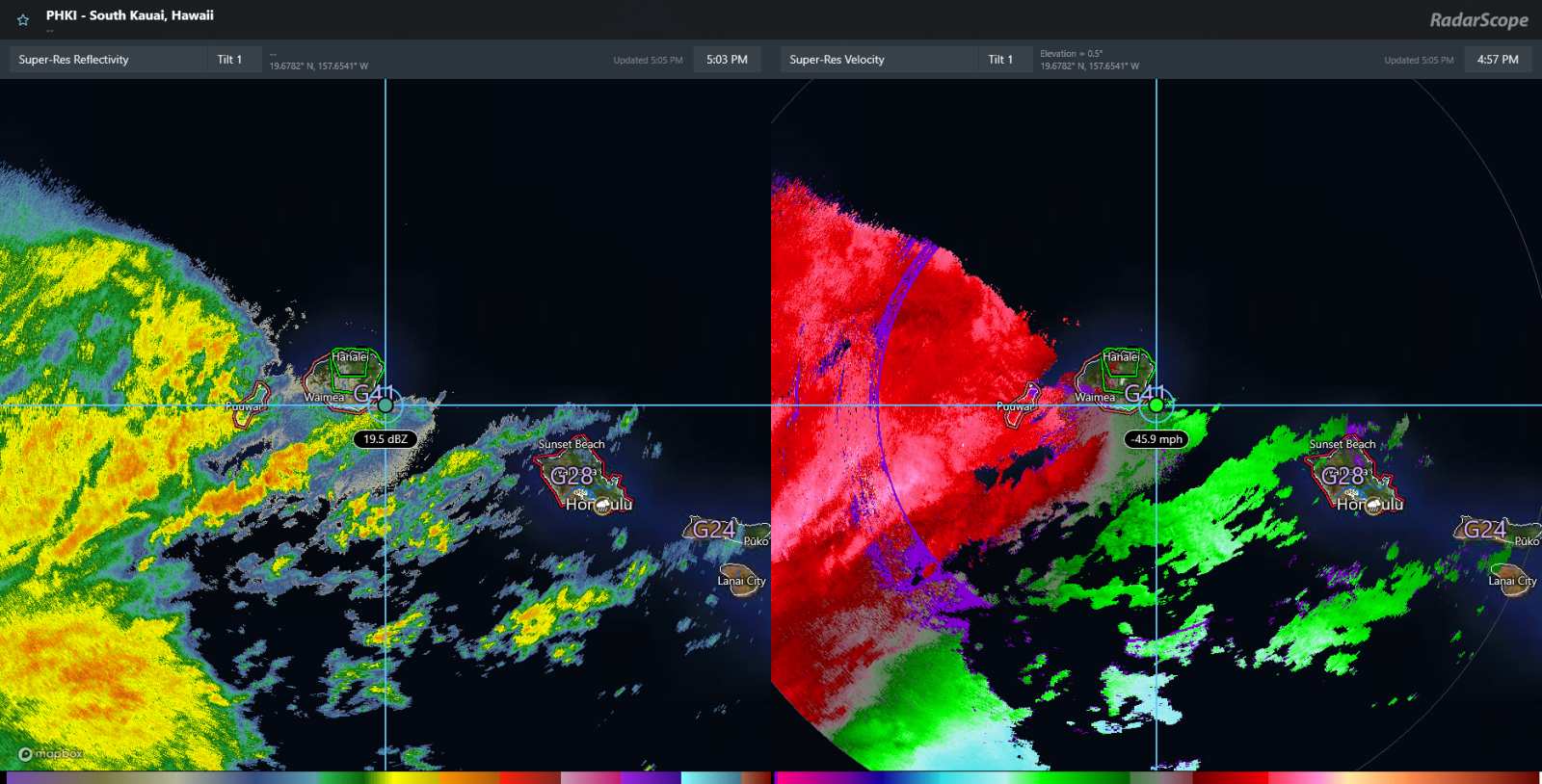 Re: Lowell: Another Hawa’i Threat?Already gusting into tropical storm force on the lower elevations of Kauai
General Hurricane Links
A curated collection of official sources, observations, models, and tropical weather commentary. For urgent weather information, always check official government sources first.
Official / Primary
- National Hurricane Center (NHC)
- Inside the Eye — Official NHC Blog
- Storm Forum (community discussion)
Satellite / Observations
- RAMMB Interactive Satellite Imagery
- Zoom Earth (storm tracks and satellite animation)
- CIMSS MIMIC-TC (microwave imagery)
- NRL Monterey (tracking maps and satellite)
- CIMSS Tropical Weather
- NDBC Buoy Data
- Caribbean Weather Observations
- Interactive Wundermap
- Animated Earth Wind View (Tropical Atlantic)
Data / Tracking / SST
- TC ATLAS (Tropical Cyclone Analysis Tool for Live and Archived Structure)
- Best Track FTP (official invest data)
- Full Active Invest / Storm List
- USNO Current Storm Information (includes Google Earth KMZ)
- Global SST Animation · SST Forecast
- NOAA Weather Radio
- Blitzortung Lightning Map
Forecast Models
Commentary / Tools
- Tropical Tidbits (Levi Cowan)
- Hurricanetrack.com (Mark Sudduth)
- Hurricane City (Jim Williams)
- TropicalAtlantic
- Storm2k
- Mike’s WX Page
- Greg Nordstrom
- Gulf Coast Weather
- American Weather
- Crown Weather (Robert Lightbown)
- The Eyewall
- Hurricane Hacker