Customize CFHC:

Meteorologist Blogs
Ed Dunham
Posting Problems & How To Avoid Them
Posted: 12:25 PM 04 May 2008
Welcome (or welcome back) to CFHC. On June 1st the Atlantic hurricane season will 'officially' start, although in a normal season the first named storm usually appears toward the end of July into early August, so this is a good time to review the protocol for site usage. Every visitor and user should review the site Rules and General Information before submitting a post. During the course of the season some of you will probably get quite upset because your post was moved, edited or deleted by a site official, so here are some tips to avoid that likelihood.

Read the various Forum Descriptions. These descriptions should help you decide where to place your post. Remember that any replies to the Main Page Talkback Article should focus on the topics that are covered in the Main Page Article itself. During the off season this rule is not as strictly enforced, but during he active season it is. If you bring up a new subject that is not covered in the current Main Page Article, there is a high probability that your post will be moved or deleted. Allowable exceptions to this include new 'named' activity that develops before a new talkback article can be posted by a site official.

You can post a different opinion (with your rationale for the difference) regarding a particular tropical system, but you cannot criticize the individual that made the post. If you do, your post will be edited or deleted. If you continue to do this, your ability to use the site will be restricted. This rule often includes organizations as well as individuals. As the season progresses, some of you will attack the NHC for their 'horrible' forecast. Don't do this without providing some strong rationale for your disagreement. Keep in mind that the NHC normally provides a forecast every six hours - and not the minute-to-minute update that some of you expect out of the NHC.

Avoid one-line posts that have no useful content. Posts like "I agree" or "Thank you for the info" or "It seems to be moving more to the west northwest now" just consume bandwidth and will be deleted. If you want to thank someone or ask them about something in their post, use the Private Message (PM) capability rather than making a post. Remember that CFHC is not a chat room - it is a discussion oriented site with numerous Forums for specific discussions. An exception to the one-line rule are links that are pertinent to the current discussion that might be useful to others.

Don't post personal information or preferences - this stuff gets deleted. Spam, advertisements, political posts, sports posts, etc., all get deleted.. Use the Everything & Nothing Forum for all other off-topic material. Don't just post something anywhere with the expectation that the Administrators/Moderators will move it into the correct Forum. If we are busy, your post will simply disappear. Don't start a post with "I know this really doesn't belong here but...". If you know that your post doesn't belong in a particular Forum, don't put it there. If you are unsure as to where to post something, ask a Moderator via the PM capability.

Do not post any material likely to cause offense, that is protected by copyright, trademark or other proprietary right - without the expressed permission of the owner of such copyright - or that contains personal phone numbers or addresses. If your post contains material from another source, the origin of that quoted material should be stated in your post. If the sole purpose of your post is to ask a question of a generic nature, e.g., "What does 'shear' mean?", put these types of posts in the Hurricane Ask/Tell Forum.

Disruptive, or bad posts will get moved to the graveyard (as well as any direct responses to a graveyarded post) to serve as an example of what not to post. If a post of yours ends up in the Graveyard, don't worry, mistakes happen. It isn't intended to humiliate, just serve as an example. The News Talkback and the Storm Forum are both strictly moderated - other forums are less strictly moderated.

If you continually post off-topic material in the Main Page Talkback article simply because you are too lazy to place your post in the proper Forum, we are likely to continually delete your posts because we might be too busy to tolerate your laziness. All of the Moderators on this site freely give of their time so that site Users and Visitors can have an enjoyable and informative place to visit. Please respect their actions and requests.

Redundancy: If a poster continually makes the same post, or nearly the same post repeatedly on the same point, it will likely be put in the graveyard and the poster be put on timed poster probation.

Entire NHC Article/Advisory Reposting: Don't do it. The main page has direct links to most of the advisories and reposting them just tends to clutter the site. Your repost is likely to be edited down or graveyarded depending on how much content other than the article/advisory is there. If you quote a specific part of an advisory or article, reposting that excerpt, with discussion, is fine.

Wave Monger - 1. n. A hurricane tracker who pines for storms. Who sees every cloud over the ocean as a potential monster heading for land. Usually tropical waves that have not formed yet. Wave Mongers are usually seen more often in the early season. They deal in hype rather than facts. 2. v. The act of hyping up a storm way before it has even formed. Wave Mongering is usually just another form of an 'alarmist' post. These types of posts serve no useful purpose - don't do it here.

Whinecasting -- Similar to wishcasting, but having someone visibly upset that the forecast was wrong and then blaming everything on anything else. Meteorology is far from an exact science. Don't blame someone else for your lack of common sense with regard to storm preparation.

Wishcasting - Act of "wishing" a storm would come your way to "add excitement". If you are really this bored, you need another hobby. This is not the thing to do. The cliche, "Don't wish too hard... You may get what you wish for", really applies here. Wishcasting and alarmist posts are prohibited. Gut feeling posts without any explanation are not allowed on the Main News talkback articles or in the Storm Forum articles - they will be moved to the Forecast Lounge (or deleted). Alarmist posts will be graveyarded. Some of our users still have difficulty distinguishing between an 'alarmist post' and the 'high probability of reality'. Contrary to urban legend, our more knowledgeable site users do not have the ability to 'change the weather' or to 'make it go away'.

Some of the above may seem a bit harsh, yet every single one of these 'posting problems' will occur multiple times during the course of any hurricane season. The added effort of correcting these infractions of the site rules means that the Moderators will have less time to provide you with the useful information that you are seeking when you visit the site. If you see something that seems improper, use the 'Alert Mods to Bad Post' link to get the attention of a site official. Please try to follow the posting guidelines so that everyone can have a quality experience here at CFHC.

Ed Dunham
CFHC Administrator
Ed Dunham
The 2007 Outlook - Updated Forecast Results
Posted: 10:21 PM 23 November 2007
Update 1/5/08
Well the season had a last minute addition in December with Tropical Storm Olga - and Karen was indeed updated to Hurricane status in post analysis. These adjustments upgraded the season total to 15/6/2, and the margins of error have been corrected in the individual tallies below., as well as the statistics mentioned in the post. With 8 excellent forecasts and 18 good forecasts, this is a significant improvement in forecast skill over previous years. Nice job!!!
++++++++++++++++++++++++++++++++++++++++++

I think that its safe to assume that this hurricane season is over, so its time to recap and see how well you did. The actual season total was 14 named storms, 5 hurricanes and 2 major hurricanes - a significant reduction in the number of hurricanes and major hurricanes from last year. The early season was dominated by a stronger than normal Atlantic ridge that kept the ITCZ and any storms that did manage to develop well to the south. The latter part of the season was dominated by increasing wind shear in the tropics that for the most part only allowed short-lived tropical storms to develop.

Here are your pre-season predictions and the total error:
CSU 17/9/5 -8
TSR 17/9/4 -7
Clark 15/9/5 -6
Ed 14/7/3 -3

MikeC 13/7/4 -5
allan 18/9/6 -10
Myles 15/9/5 -6
sara33 15/5/3 -2 (winner)
BC Francis 13/5/2 -3 (honorable mention)
madmumbler 12/8/4 -7
jojoindian6 13/8/4 -6
Lamar-Plant City 19/8/4 -8
Storm Cooper 11/5/2 -5
VMI Bran 13/7/3 -4
Mad Dog 14/6/3 -2 (winner)
sauki 13/6/3 -3 (honorable mention)
Lois Cane 16/7/4 -4
Ftlaudbob 16/10/5 -8
Met Oc 18/10/4 -9
New Watcher 16/9/6 -8
Hurricane29 16/9/4 -6
Tak 15/8/4 -4
native 19/9/6 -11
doug 16/8/4 -5
HanKFranK 14/8/4 -5
Robert A 17/7/3 -4
HCW 17/10/4 -8
Dem05 16/8/4 -5
Valandil 16/9/4 -6
Nateball 15/7/3 -3 (honorable mention)
Bee-Beep 16/8/4 -5
Bloodstar 22/11/6 -16
John C 11/5/2 -5
Stormchazer 15/8/3 -3 (honorable mention)
DMFischer 18/7/4 -6
weatherwise911 19/10/5 -11
CMD Orlando 19/10/5 -11
Psyber 14/6/3 -2 (winner)
cieldumort 15/9/5 -6
Lysis 20/10/7 -14

The average forecast was 16/8/4 -5 (good), and indicates that many storm trackers will usually forecast a busy season, i.e., the desire to have lots of systems to watch. As an example, for folks on this site only 4 forecasted less than 6 hurricanes, 10 folks forecasted 6 or 7 hurricanes - and 26 forecasted 8 or more hurricanes. There were 12 forecasts of less than 15 named storms, 6 forecasts of 15 named storms and 21 forecasts for more than 15 named storms. There were 9 forecasts that exceeded the CSU and TSR forecasts of 17 named storms, 2 forecasts that equalled the CSU/TSR forecasts and, much to your collective credit, 27 forecasts that were for fewer named storms than the CSU/TSR outlook.

Skill Table
-1 to -3 Excellent (8 forecasts)
-4 to -6 Good (18 forecasts)
-7 to -9 Fair (6 forecasts)
-10 or more (6 forecasts - contact sara33, Mad Dog and/or Psyber for additional training )

Besides Clark & myself, 36 of you were kind enough to participate in this annual site ritual which is an excellent participation rate and I thank all of you for trying. More important than the numbers themselves are reflections over the season and why a forecast was good or not so good. Who did the worst? Well, none of you. I'd probably give that dubious honor, from a meteorological standpoint, to CSU and their Oct/Nov forecast of 4/2/1. The actual was 1/1/0 (-5 for a two month forecast)

CSU will issue their summary analysis of the 2007 season on November 27th and their initial outlook for the 2008 season in early December - and we'll start the process all over again.
Cheers,
ED
Ed Dunham
Wave Mongering - Part II
Posted: 01:06 PM 09 September 2007
Tomorrow, September 10th, is the statistical peak of the hurricane season and the Atlantic basin is showing signs of increasing tropical activity.

Tropical Storm Gabrielle just made landfall at Cape Lookout, North Carolina, and a more northeastward movement is anticipated this evening. Gabrielle is still encountering some north to northeasterly shear which should keep the maximum surface winds offshore as she merges with an extratropical low off southeast New England on Wednesday or Thursday.

Upper level low in the Bahamas, with a surface reflection near 27.4N 77.1W at 09/14Z, is drifting slowly to the northwest under southerly wind shear. Additional development is not anticipated, however showers and squalls are likely over the Florida peninsula today, tonight and on Monday.

Invest 90L in the east central Gulf of Mexico near 23N 87W at 09/14Z is currently stationary and quite disorganized with easterly shear to the immediate north of the system. Given the rather hostile environment, development is not expected.

Invest 91L in the far eastern Atlantic near 10N 34W at 09/14Z is moving west at 10 knots and slowly becoming better organized. Additional development seems likely with movement to the west but becoming west northwest in a couple of days as the system continues to consolidate. Slow movement westward at about 10-12 knots into an area of lighter wind shear.

Finally, recently designated Invest 92L near 17.3N 57.5W at 09/14Z has become much better organized in the past 24 hours. Movement is to the west at 12 knots. This system will be moving away from a zone of westerly shear into an area of almost no wind shear. A west northwest track is anticipated. Additional development is quite likely and residents of the Bahamas and the southeastern U.S. should closely monitor the development of this potentially troublesome system.

Lots of areas to keep an eye on as the hurricane season hits its peak.
ED
Ed Dunham
Wave Mongering
Posted: 01:49 PM 30 August 2007
Well, not really. Lots of excellent posts on the Main Page thread have covered the potential hot spots, but only a couple of them are likely to amount to anything.

Invest 97L continues as an active wave in the southern Bay of Campeche, however, it is about to move inland into east central Mexico near 19.5N and bring another round of heavy rain to that region. No further development is expected.

Invest 96L near 36N 70W at 30/16Z has an elongated NW-SE orientation with convection mostly to the southeast of the low center. Some development is possible as the system moves off to the northeast ahead of a frontal zone - probably as an extratropical or subtropical system.

Very little remains of Invest 95L located well east of Daytona Beach. The system should dissipate as dry air continues to weaken the remnants of this marginal low pressure area.

Invest 94L near 11N 53W at 30/15Z is moving west at about 14 knots and it is a little better organized today. Convection is still displaced to the east and southeast of the weak low pressure center. Slow organization still seems likely over the next couple of days as upper level conditions slowly improve. Note that dry air is still plentiful but on the wane in the Caribbean Sea.

Finally, a large tropical low near 14N 28W at 30/15Z is moving west at about 12 knots. Modest convection but good consolidation earlier today with a large circulation envelope could make this system the one to really watch next week. Slow development seems likely over the next few days as the wave continues on a westward track.
ED
Clark Evans
Questions with Dean: Gulf of Mexico track?
Posted: 04:20 PM 17 August 2007
An hour to go until the 5p advisory, though all of the particulars are probably getting announced to the various NWS offices on the standard conference call as I speak. Here's what I see as the main question: the forward speed of both Dean and the upper low near Florida. The GFDL has been showing the fastest forward speed of all of the models plus the slowest retrogression of the upper low. This isn't counterintuitive, as they are being steered by two different ridge centers right now. The other models are a tad slower with Dean and a tad faster with moving the upper low out of the picture, resulting in a more westward track. Which is going to win out, or as is the case with so many things in the tropics, does the true answer lie somewhere in between?

Right now, the consensus models as well as most of the globals are clustered fairly tightly over the northeastern portion of the Yucatan peninsula. The GFDL, some of its variations, and many of the GFS ensemble members are the ones that are significantly further north of that area. Regarding the ensembles, one has to ask the question of if the perturbation method used to create the ensemble initial conditions is leading to a scenario where the storm interacts with a slower-moving or more intense upper level feature in the Gulf? Comparing the 12z early guidance to the 12z ensembles, there's not a ton of speed difference between either cluster of models, making me think that the other scenario of more upper level interaction is more likely than anything related to how they represent the storm.

It's unnerving to be 3 or so days away and not have a better idea of what is going to happen, but I think we'll know by tomorrow morning whether the GFDL solution is out to lunch or if it is a very viable possibility. How this upper low and storm start to evolve today is going to be key, I think, moreso than any potential land interaction that Dean could have until it nears the Yucatan. I hope the comments above highlight this possibility and the thinking that goes into the track forecast making process when it comes to evaluating model guidance as a whole.

For now, however, the consensus track is the 'option of least consternation' -- and the track that both I and the NHC are going with right now -- but that could change as we get into tomorrow morning.
Clark Evans
Tropical development in the N. Gulf this week?
Posted: 04:43 PM 31 July 2007
Milling about the tropics and the various weather fields, my attention focused close to home last night (even despite the newly-christened Chantal). The northern Gulf coast over the next few days might just become the second area to follow for this week. Last week, the Paul Roundy genesis tools -- using no model forecasts! -- suggested the northern Gulf as a potential genesis region into later this week. Lo and behold, I think we might well have a shot of that verifying.

An old frontal boundary should slide into the northern Gulf waters in the next day or so while an upper ridge builds in over the Bahamas. Before this boundary tries to lift back north, there is an increasingly likely chance that an area of low pressure tries to form somewhere in the N. Gulf from south of Baton Rouge to south of Apalachicola. Model guidance is hinting at a broad area of lower pressures and, with the building ridge, upper level conditions should be at least moderately favorable for development. (And, as we all know, the waters of the N. Gulf are like bath water right now -- SSTs in the upper 80s in many areas.)

The part of the boundary east of Florida over the Gulf Stream may also try to spin up an area of low pressure, one that would likely scoot out NE as Chantal is doing, but the thermodynamic structure of any potential development there is more iffy than in the Gulf.

It's no slam dunk by any means, but watch close to home very carefully over the next few days. Any potential threat looks to be from the MS coast eastward toward the Florida Big Bend...but again, this is an uncertain forecast.
Clark Evans
Watching the Eastern Tropical Atlantic
Posted: 10:51 PM 27 July 2007
This blog entry attempts to highlight the sorts of products meteorologists will look at and consider when diagnosing whether or not conditions are favorable for tropical system development and/or growth. It's generally a step-by-step process, boiling down the features that we see in the ocean and atmosphere when tropical systems develop and looking at maps of related quantities to gauge how well current conditions match to those features.

First -- what's at the low levels? Using two merged QuikSCAT passes from earlier today, the 850mb streamline analysis from TAFB (http://www.nhc.noaa.gov/tafb/QUNA00.jpg), and the latest SST map across the region (see http://www.nhc.noaa.gov/aboutsst.shtml), I've created this composite map of what we have out here:


Red denotes trough axes; in blue are the 26C and 27C SST isotherms. Note the low being on the cyclonic shear side of what I'll call the low level westerly jet. This is a favorable position for development/maintenance of the low feature and this setup is somewhat akin to a monsoonal trough. The SAL does not appear to be a concern in hindering anything out there right now.

Shear maps from the Univ. of Wisconsin site suggest ample shear south of 10N, but I think this is being somewhat skewed by the westerly LLJ located underneath the African easterly jet at 600-700mb; underneath the subtropical ridge, winds are fairly favorable. Compare the following two images from the Univ. of Wisconsin site, first the deep layer wind shear (upper levels minus low levels) followed by the mid level wind shear (mid levels minus low levels).


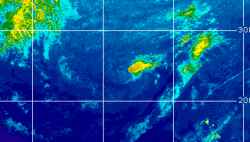
Note how 30-40kt of mid-level shear shows up as merely 20kt of deep layer shear; this is because of the strength of the African easterly jet in feeding these waves at mid-levels coupled with the westerly LLJ providing an ample source of vorticity at low levels. Simply put, shear is not really a concern. So, the majority of the necessary underlying conditions are present for tropical cyclogenesis, but there are two key factors holding things back: SSTs and low level stability. As discussed in my "Slow start to CV season ahead?" post from last week, the SSTs out there are chilly (both overall and compared to climatology) and there is still significant low level stability underneath the trade wind inversion associated with the subtropical ridge, quite possibly being fed by the cooler SSTs. Compare the composite map above to a current IR satellite image from the region:


Indeed, it's not merely coincidence that regions of cooler SSTs and the more stable environment match quite well.

Putting it all together, the CIRA/SSD tropical cyclone formation probability product (see http://www.ssd.noaa.gov/PS/TROP/genesis.html) shows fairly high (climatologically speaking) probabilities of formation in the Eastern Atlantic. Looking at the individual components, however, there is one that sticks out like a sore thumb in limiting these probabilities from being even higher: yes, it's the low level stability. The genesis threshold is >-8C, so it is above that, but it is nothing like what is observed further west in the basin. Vertical instability is crucial to convective growth and, ultimately, organization and development.


Overall, as I've noted before, if anything can stay south of 10-11N, it's got a pretty favorable environment. Otherwise, it seems as though 45-50W is a more likely location for genesis than the deep tropical Atlantic.

So, I wonder out loud, could this wave, rather than being one to develop, be the one that provides enough ambient vorticity and "oomph" (for lack of a better term) to precondition the low levels in the eastern Atlantic for future developments? That inversion can be weakened from below as well as it can from above, including through mixing processes (e.g. by the wind) and heating processes. The models, particularly the GFS and the ECMWF, are sensing that overall, conditions are pretty favorable for development. They may not be handling the low levels quite as well as we'd like, though, given the relative lack of available data in the tropical east Atlantic. The result is a strong genesis signal, but one that may need to be muted just slightly.

Still, as long as these types of conditions hold within the basin, we're going to have to keep a very close eye on what is going on out in the Atlantic. I hope this has been a somewhat useful guide both to what is currently occurring within the basin as well as to the overall process of tropical weather forecasting. If you have any questions, please feel free to ask them in the "Blogger Discussion Forum" and I'll do my best to tackle them!
Clark Evans
A slow start to Cape Verde season ahead?
Posted: 06:26 PM 22 July 2007
A couple of early season Cape Verde tropical waves have come and gone thus far this season without much fanfare. Meanwhile, a chain of waves over Africa is currently looking fairly impressive for this time of year. Entering late July, we're moving into a time period where, climatologically-speaking, we start to turn our focus a bit more toward the central and eastern Atlantic. Putting those second and third elements together, one might surmise that one of those forthcoming disturbances might have a good shot at developing -- perhaps one of the later ones, after the others have 'preconditioned' the environment with ample low level moisture.

I'm not so sure of that. In fact, I think we might see somewhat of a delayed start to the Cape Verde season. Take a look at this SST anomaly map from today:
http://weather.unisys.com/archive/sst/sst_anom-070722.gif

Over the past month, the magnitudes of the negative SST anomalies in the main development region (MDR) of the tropical Atlantic have maintained themselves and expanded westward from the coast of Africa to now encompass the entire MDR between 10-20N. This is better highlighted by looking at the change in SST anomalies from mid-June to mid-July; if you use the Unisys archives at http://weather.unisys.com/archive/sst/ you can see them for yourself.

Currently, SSTs across the region look like this: http://www.nhc.noaa.gov/tafb/atl_anal.gif (time-sensitive).

In general, SSTs are at about 27C along 10N from the coast of Africa to 50W and cool to about 25C north of there.

And the result? Significant low-level stability, both in terms of cold air stratocumulus forming above the cooler waters as well as a strong trade wind inversion due to significant ridging across the region. You can see the stratocumulus for yourself by using the visible satellite image from http://www.ssd.noaa.gov/PS/TROP/DATA/RT/EATL/VIS/20.jpg (updated in real-time; not particularly time-sensitive).

Disturbances south of 10N have a somewhat favorable environment in which they can develop, but north of 10N is a different story -- and it appears that the ITCZ is already at or near that latitude. That means that we're likely still some time away from a significant Cape Verde threat.

How long will this last? Not sure, though climatology argues that even if the SSTs and low levels remain 1C below normal they will still rise above the typically accepted thresholds for development into August. But, as has been shown in various threads here, there is quite a bit of heat content available in the western Atlantic, Gulf, and NW Caribbean. Conditions for development improve west of 50W, suggesting that disturbances that can hold together until the Lesser Antilles and find a favorable upper level environment could pose a threat to North America and the Greater/Lesser Antilles.
Clark Evans
Trouble in the Gulf, Aid for the Southeast
Posted: 11:30 PM 31 May 2007
This evening, a well-defined tropical disturbance is located in the extreme southern Gulf of Mexico, with the surface circulation and lowest pressures found on the northeastern tip of the Yucatan Peninsula per a QuikSCAT pass from earlier this evening. Maximum sustained winds associated with this feature are on the order of 25-30kt, higher in convection and localized gusts.

QuikSCAT pass (time-sensitive!)

Convection associated with this feature is highly disorganized at this time, with a band of deeper convection found southeast of the center in the NW Caribbean Sea. Convection over Honduras and Central America at this time is not associated with this disturbance; it is moreso associated with the diurnal convective cycle across the region. The system is quite lopsided to the downshear side of the storm, or toward the direction that the wind shear is pointed towards. Wind shear in the region is lowest in the NW Caribbean and highest in the central Gulf, increasing from 10-20kt in the former to 50-60kt in the latter. This is associated with a cut-off trough of low pressure in the upper levels of the atmosphere over the central Gulf; it is this feature that will provide clues on the ultimately intensity and path of whatever comes out of this disturbance.

On a broader scale, the flow over the continental US is quite stagnant thanks to a cutoff upper level low over the central United States and the aforementioned cutoff trough in the Gulf of Mexico. A Pacific jet is serving both to enhance severe weather potential across the central United States tonight but also to amplify the trough in the Gulf. There are no significant features in play over the northern Pacific to cause the cutoff low over the northern Plains to move significantly in the next couple of days; the same may hold true for the trough in the Gulf, but that's a tad trickier to diagnose just from water vapor satellite imagery. Of course, that's where the ultimate track forecast uncertainty lies -- can't ever have anything easy!

So, two questions -- track and intensity/structure. Let's cover the latter one first. Sea surface temperatures across the Gulf of Mexico are favorable until about 28N latitude -- about the latitude of Tampa, basically -- and then quickly drop off in both temperature and oceanic heat content toward the north. Any sort of warm core (re: tropical or subtropical) development is likely going to have to occur sooner rather than later as a result. Furthermore toward this point, upper level winds and vertical wind shear only increase to the north in association with an upper level jet streak aimed directly at the eastern Florida panhandle, suggesting an increasingly hostile environment for tropical or subtropical development as the disturbance goes north. However, as it accelerates north, storm-relative wind shear will tend to decrease somewhat, potentially allowing it to maintain itself somewhat better if it gets organized sooner. So, the key is, when does this thing get sufficiently well organized to draw further interest? If it's going to happen tropically, it needs to do so tonight. Watch the convective evolution over the southern Gulf tonight; if there is a flareup somewhere in there tonight, tropical development is more likely. If it can only develop a low-level warm core that recon can detect, the NHC is likely to classify it as tropical if for no other reason than for public notification purposes for an eventual landfall. No convective burst and tropical development potential starts to dwindle somewhat, particularly given the asymmetric structure it is already displaying on satellite imagery -- not really extratropical, but not purely tropical either. My best bet is a hybrid structure from here on out, but that says nothing about what it actually gets classified at; see the sentence a couple of lines back for my thoughts on that matter. Supporting evidence for the hybrid structure call comes from the various cyclone phase space forecast depictions for what low can be tracked by the models.

Cyclone phase space diagrams

Onto the ultimate track of this feature. Recall that tropical cyclones tend to be steered to first order by the mean wind in the atmosphere, with weaker storms going moreso with the lower-level wind flow and stronger storms moreso with the upper-level wind flow. To second order, the center of circulation can jump around in response to convective development and other things of that ilk; we saw this with Alberto last year, where the center jumped toward the convection a couple of times. In general, with the upper level flow pattern the way it is, this would suggest potential jumps north and/or slightly east. Right now, the lower-level wind field would tend to steer the disturbance more westerly, whereas the upper-level wind field would tend to steer it more northerly or northeasterly. This is well-captured by the Univ. of Wisconsin mean layer steering flow products linked below.

UWsic Steering Flow Products

Extratropical and hybrid storms, however, tend to move moreso with the strongest mid-level height falls and vorticity advection and/or toward the areas of greatest baroclinic energy. In general, this is going to be ahead of the upper-level feature and often embedded within an upper level jet streak, such as the one pointed at the eastern Florida panhandle right now. This isn't much different than what the tropical steering flow diagrams suggest, for what it's worth. However, is this going to change at all? Is the upper trough in the Gulf going to move, amplify, etc.? Tough to tell just looking at water vapor imagery, but it at least does give us an area to look at.

Thus far, this discussion has focused more on the observations than the models and their forecasts. So, what do the models say? The model tracks are across the place from the western Florida panhandle to the Tampa Bay area. The upper-level pattern is such that areas further west don't have a lot to worry about while areas further down the Florida peninsula should just watch this for the rain potential. In general, the models disagree on how much pivoting the upper level trough in the Gulf is going to do over the next two days; the models that pivot it a bit more east have the disturbance making landfall further east, as expected. Couple of things to note...

1) The upper ridge over the southeast and western Atlantic, while weakening, has been strong for quite an extended period of time and at least partially responsible for the drought conditions across the southeast -- possibly slightly enhancing the intensity of the ridge through surface heating feedbacks.
2) A strong Pacific jet across the southwest United States is heading toward the Gulf and the upper trough, but indications are that the flow is moreso being redirected into digging the feature rather than moving it along. Nothing in the upper air data suggests that the cutoff low over the northern Plains will help to kick this along either.

There has been some discussion elsewhere about using the NAM to look at this disturbance and its forecast evolution. While the NAM is generally not a good tropical model in the least, given the strong extratropical (re: midlatitude) influences at play and the overall poor performance of the model suite at large lately, I believe it should be given slightly more weight than would normally be warranted for a tropical-type of situation. It has generally been consistent with its forecasts but also west of most of the other models. However, the other models through the day Thursday were gradually trending toward the north and west again, for what it's worth (not necessarily a whole lot). What does that all mean?

Model guidance -- see Jonathan Vigh's page for many output plots -- is generally clustered in the Cedar Key to Tampa Bay area, with some outliers further west. The ECMWF, last season's best model particularly in the medium-long range, has been on the western end or slightly further west of that guidance envelope. This gives me confidence in an Apalachicola to Crystal River, FL impact area, aiming at the same general area that Alberto made landfall at last season. Timing? Looking at about 2-2.5 days out right now, toward the earlier end of that range if the center doesn't redevelop back in the NW Caribbean near the convection overnight.

What impacts can be expected? Mostly a rain event. Even if this develops tropically, wind speeds are not likely to be significant -- weak to moderate tropical storm at best given the environment -- and as a result waves and surge aren't likely to be all that significant either. Areas along and east of the track can expect to see several inches of much-needed rainfall. This includes coastal areas of the SE as well. Note that extratropical storms -- or storms that undergo extratropical transition from tropical storms -- sometimes have a tendency to have precipitation distributions that shift from predominantly NE of the center to NW of the center. I don't think that this will happen to any large extent for Florida or coastal Georgia right now, but as the system moves up the coast into the late weekend/early next week and topographic/orographic effects take hold, this might become a tad more significant. In short, except 1-2" of rain over a broad area from Panama City, FL north and east, with locally heavier amounts where the greatest moisture feed sets up -- 3-6" if not 8" in the most significant areas.

If anything, we're officially bringing in the 2007 with a bang tonight and we have a lot to look at into our weekend.
Ed Dunham
The Trouble With May
Posted: 12:20 PM 26 May 2007
Recently a post made reference to a statement from another site that "No tropical cyclone landfalls are expected along the United States mainland." In my opinion, that statement falls into the categories of irresponsible and/or foolish (and probably others as well). For some of you, this blog will fall into the category of 'things that you really didn't want to know', but at least its based on climatology rather than conjecture.

With the development of Subtropical Storm Andrea earlier this month, I decided to take a look at past seasons that also had a tropical or subtropical storm in May. Since May storms are uncommon events, would it be reasonable to expect that similar oceanic and atmospheric conditions might have existed for seasons with a May storm event? Could anything of interest be extracted from the storm database for those seasons that would hint at likelyhoods for this season? Maybe - you decide.

With only 14 prior events, the database is quite limited - note that the storm of 1861 appears to be a database error and it was not included.

..........NEXT......LAST.......TOTAL..........LANDFALLS
YEAR...STORM...STORM.....STORMS...........US.........FLORIDA
1887.....May........Dec.......19/11/2........5/3/0........2/1/0
1889.....Jun.........Oct..........9/6/0.........3/1/0........3/0/0*
1932.....Aug.........Nov........11/6/4........5/2/1........1/0/0
1933.....Jun.........Nov........21/10/5.......6/5/1........3/2/1
1934.....Jun.........Nov........11/6/0.........6/4/0........2/0/0
1940.....Aug.........Oct..........8/4/0.........3/2/0........1/0/0
1948.....Jul..........Nov..........9/6/4.........4/3/2........3/2/2
1951.....Aug.........Oct.........10/8/5........1/0/0........1/0/0
1953.....Aug.........Dec........14/6/4........6/2/0.........5/1/0
1959.....Jun.........Oct..........11/7/2.......6/3/1........2/0/0
1970.....Jul..........Oct..........10/5/2.......3/1/0........1/0/0
1972.....Jun.........Nov..........7/3/0.........2/1/0........1/1/0
1976.....Aug........Oct..........10/6/2.......4/1/0........2/0/0
1981.....Jul..........Nov.........12/7/3........2/0/0........1/0/0
Avg.......Jul.........Nov.........12/7/2........4/2/0........2/1/0

*In 1889, one storm made landfall as a hurricane in Louisiana and as a tropical storm in Florida.

Does a tropical storm in May hint at how busy the season will be? The answer is 'no'. Two of the busiest seasons on record (1887 & 1933) had a tropical storm in May - and two relatively quiet seasons (1940 & 1972) also had a storm in May. HOWEVER, based on the limited database:

Probability of a U.S. Tropical Storm landfall: 100%
Probability of a U.S. Hurricane landfall: 86%
Probability of both a TS and a Hurricane landfall: 86%
Probability of at least 3 U.S. landfall events: 71%

For Florida:
Probability of a TS landfall: 93%*
Probability of a Hurricane landfall: 36%
Probability of both a TS and a Hurricane landfall: 29%
Probability of at least 3 landfall events: 29%

* In 1972 there was not a TS landfall in Florida - but there was a Hurricane landfall, i.e., the probability of one or the other in Florida is 100%.

Exclusive of Florida there is a probability of 64% for a U.S. Tropical Storm landfall and a 71% probability for a U.S. Hurricane landfall (and a 57% probability for both).

Does all this mean that a U.S. landfall will occur this year? Again, the answer is 'no'. Does it imply that one is quite likely? Until a season breaks the trend, I believe that the answer is 'yes'.

Place your bets, but lean toward the side of caution and stay prepared.
ED
Hurricane Ask/Tell
Hurricane29
(2 replies)
Initial Outlook for the 2008 Season
2008 Storm Forum
Ed Dunham
(39 replies)
Initial Outlook for the 2008 Season
Hurricane History
doug
(10 replies)
FSU stats re: HURRICANE DAYS THIS YEAR; historically low
Hurricane Ask/Tell
Ed Dunham
(2 replies)
Tropical Weather Outlook (TWO)
Other Weather Events
Lamar-Plant City
(5 replies)
SSTs revisited
CFHC 2007
CFHC is a Weather Enthusiast Run Site Focusing on East Central Florida and the Entire Atlantic Hurricane Basin since 1995
Maintained by:
John R. Cornelius - Cocoa, FL
Michael A. Cornelius - Orlando, FL
Meteorologist Ed Dunham - Melbourne, FL
Site Design by:
Christine M. Hahn - Bechtelsville, PA
CFHC is NOT an official weather source, please only use us as a supplement to official weather outlets.
10599006
Note: This is NOT an official page. It is run by weather hobbyists and should not be used as a replacement for official sources. 
CFHC's main server is colocated in at Atlantic.net in Orlando, Florida
Image Server Network thanks to Zimmerman Development, Skip Link, LLC, Pioneer Technology Group,Tele-connection web services and NDSI Software. Some Maps Provided by:
Skeetobite Weather.
Great thanks to all who donated and everyone who uses the site as well.
Site designed for 800x600+ resolution
When in doubt, take the word of the National Hurricane Center