Tropical Storm Barry Landfalling Along Veracruz State. Flood Threat Rising.
Posted: 07:58 AM 17 June 2013 | 6 Comments | Add Comment | Newest: 02:50 PM 19-Jun EDT
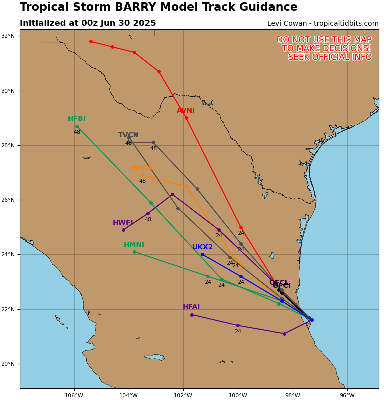
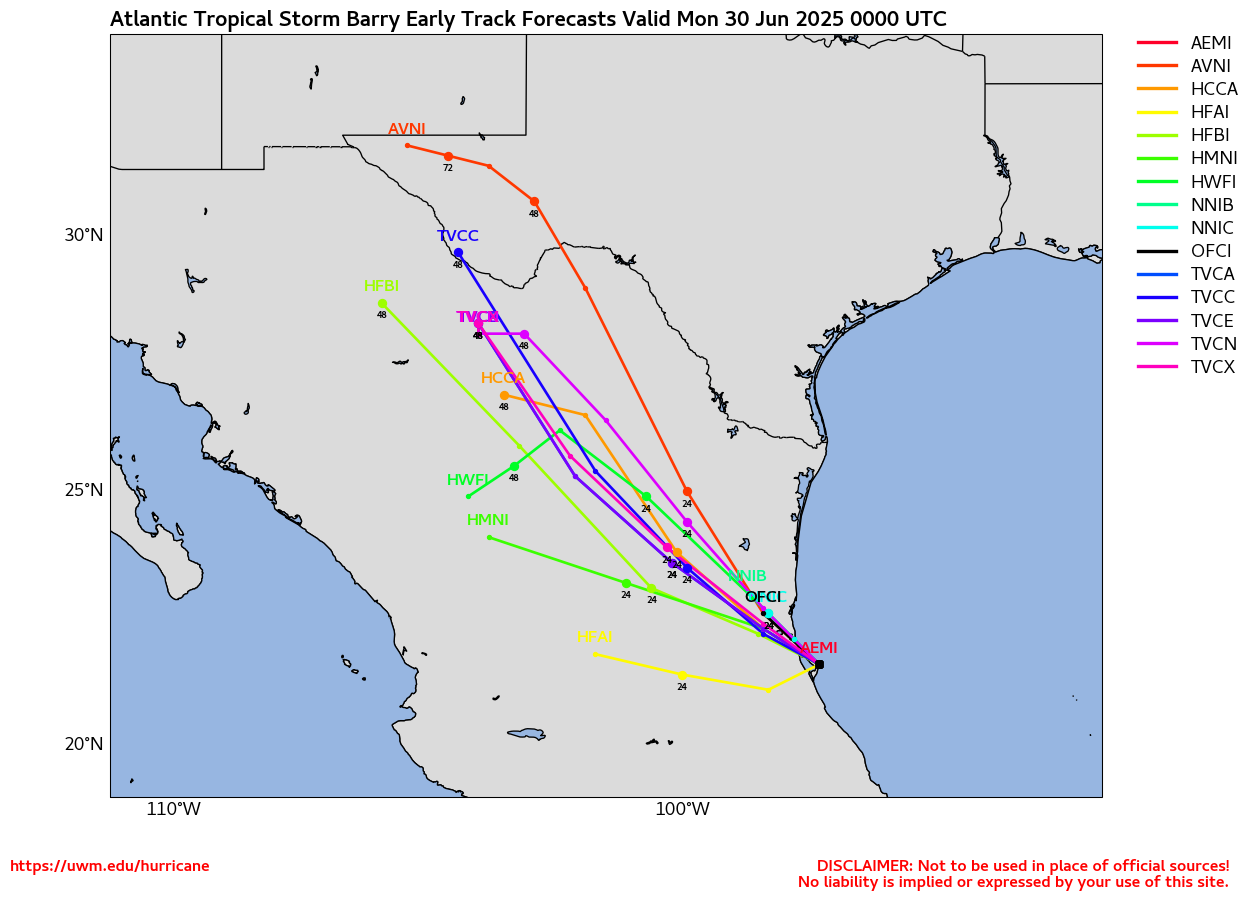
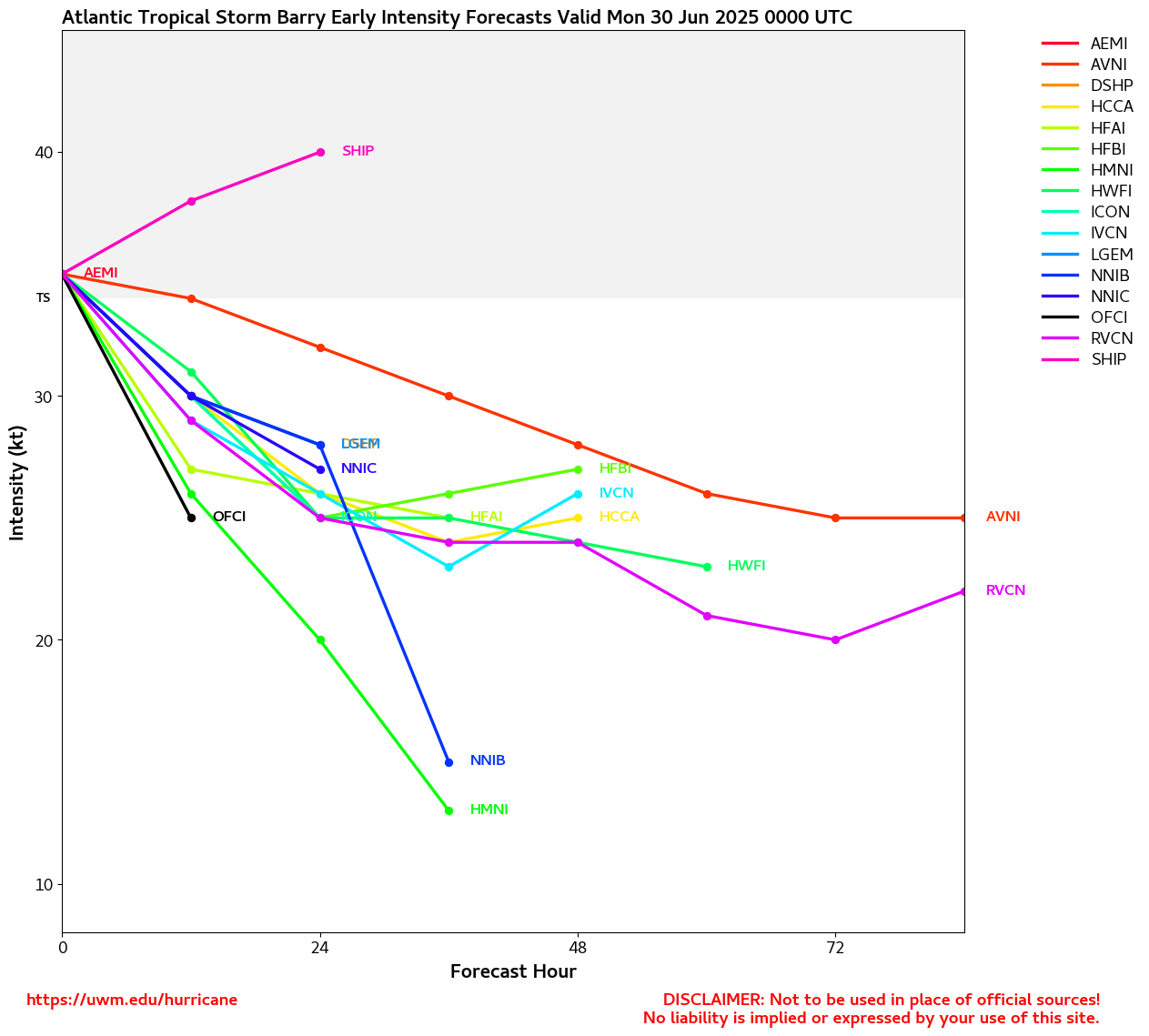
Barry is making landfall on the Mexican state of Veracruz as a 45MPH tropical storm. While the strongest winds are almost all occurring offshore, a few potent gusts can be expected in spots over land.
Of far more concern is the growing risk of life-threatening flooding and mudslides, as Barry slowly pushes inland over increasingly mountainous terrain. Widespread rainfall totals of 3" to 5" are expected, with localized totals over 10" possible.
Ciel
11AM CDT 19 June 2013 Update
Recon is en route to find out if TWO has become Barry - with an upgrade to named storm very likely sometime today. A Mexican navy meteorological station has already recorded nearly 1-min sustained winds at tropical storm force north of the estimated center.
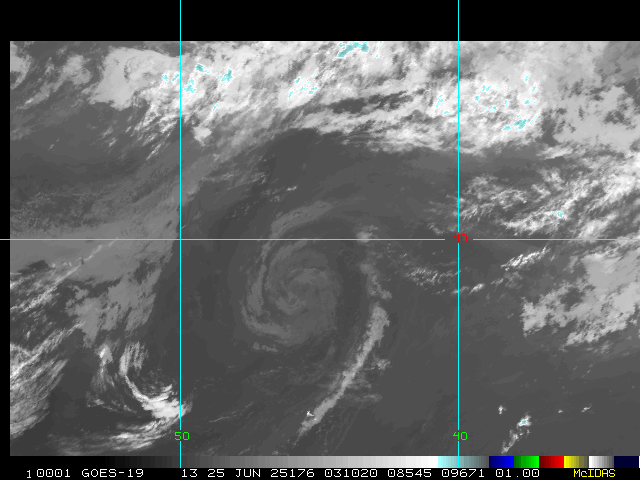
As for track and timing, recon should help determine if the old surface center still holds, or has been/is being replaced by the vigorous mid-level circulation establishing itself at the surface, which is to the north of the old LLC. High res satellite images suggest the latter, and indeed it is the northernmost circulation that NHC is tracking and forecasting on.
Ciel
Weather Conditions at Veracruz, Mexico
Weather Conditions at Poza Rica de Hidalgo, Mexico
4AM CDT 19 June 2013 Update
The structure of TD2 has continued improving overnight, although a recent ASCAT pass from late last night really highlighted the strained call as a tropical cyclone, as the surface center and mid-level center were still miles and miles apart, with the surface center even still interacting with land. On the other hand, that ASCAT pass also suggested maximum sustained winds at the surface have likely increased to about 35MPH.
Considering the improved banding, increased deep convection within the mid-level center, and that most of the system is now over water, only an easily achievable tiny increase in maximum sustained winds would now make the depression a storm, and so the government of Mexico has chosen to upgrade from watch to warning: A Tropical Storm Warning is now in effect for a considerable portion of the state of Veracruz, from Punta el Lagarto to Barra de Nautla.
The main threat with TWO will continue to be from heavy rain and potential flooding, whether the cyclone becomes a named storm, or remains a depression.

Ciel
2PM CDT 18 June 2013 Update
What remains of TD2 is rather ill defined today. It appears that there are multiple surface or near surface swirls traveling with what might be an open wave at this point. However, for continuity purposes, and the likelihood that the area of disturbed weather will be back out over open water very soon, NHC has opted to operationally follow this as if it were still intact, but it remains to be seen if what is left of TD2 can sufficiently reorganize once back out over the Bay of Campeche.
The primary swirl associated with Two is presently located near 18.5N 91.8W, and is within hours at the most of at least partially reemerging over very warm water. On its current projected course, which Two or its remnants look to be following well, the low will probably spend a few days over the Bay of Campeche, before moving back inland along extreme southern Mexico.
The primary concern with Two continues to be its potential to cause heavy rains and flooding.
Ciel
Original Update

An early season tropical wave, Invest 93L, has been pulling partially offshore overnight Sunday in the northwest Caribbean, and it appears that some semblance of a surface circulation has been taking shape, at least sporadically, despite so much of the disturbance's core traveling over land.
While 93L is the kind of tropical low pressure area that may very well become a tropical cyclone while riding the coast, its odds of becoming an officiated tropical cyclone would still be much better if it either pulls or re-centers further north, over the warm waters of the northwestern Carib.
Being that 93L is already moving along and/or over so much land, and that Belize and the Yucatan are just up ahead, any further development will be restricted by time. However, regardless of development, very heavy rains with the potential for dangerous inland flooding will occur for some time to come along its path.
By mid-week, it is possible that 93L will track into the Bay of Campeche, and have another shot at significant development. Alternatively, 93L may just rain itself out over southern Mexico, or even pass into the eastern Pacific, and possibly develop over there.
One way or another, 93L looks like it will be around for a while, and so we will likely continue monitoring this feature for several days.
Weather Conditions at Roatan Island, Honduras
Weather Conditions at Belize City, Belize
Weather Conditions at Aeropuertola Aurora , Guatemala
Barry Event Related Links
Animated Skeetobite Model Plot of Barry
SFWMD Model Plot (Animated Model Plot) SFWMD Hurricane Page (More Tracking Information)
Clark Evans Track Model Plot of Barry (Animated!) Model Plots in Google Earth - In Google Maps
Clark Evans Intensity Model Plot of Barry Clark Evans Track Plot of Barry (Animated!)
Clark Evans Top 10 Analog Storms for Barry
More model runs on from RAL/Jonathan Vigh's page
NRL Info on Barry -- RAMMB Info
Floater Satellite Images:
Visible
(Loop),
IR
(Loop),
WV
(Loop),
Dvorak
(Loop),
AVN
(Loop),
RGB
(Loop),
Rainbow
(Loop),
Funktop
(Loop),
RB Top
Loop)
Andrea Heading Up & Out - Last NHC Advisory Written
Posted: 07:43 AM 06 June 2013 | 9 Comments | Add Comment | Newest: 07:08 PM 06-Jun EDT
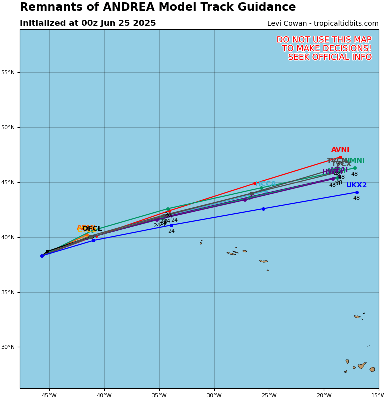
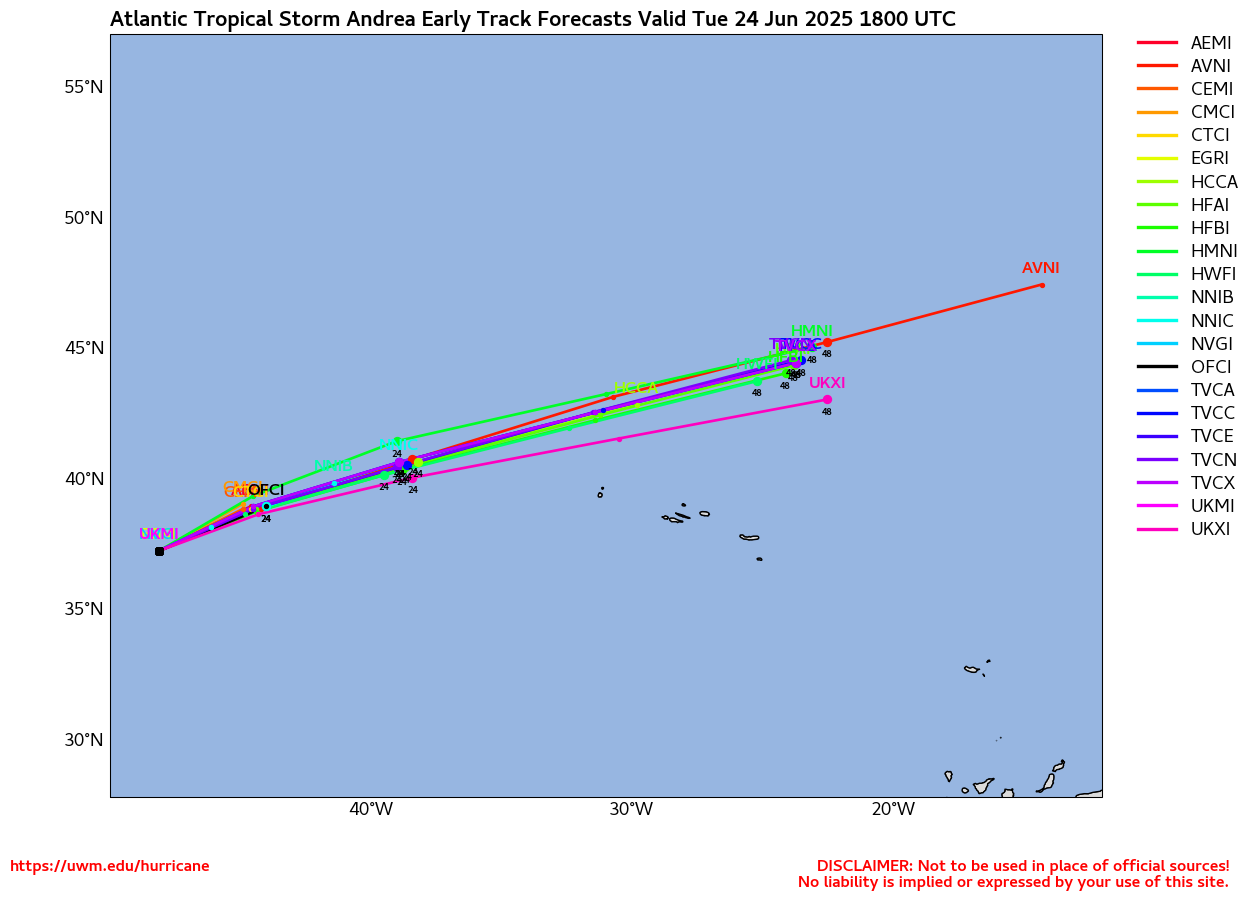
This is just a quick update to note that the last official advisory on PT Andrea has been written by NHC. PT Andrea is now racing out to the north-northeast, and almost all of the US-related weather is either soon coming to an end in Maine, or already well offshore. Atlantic Canada will still have a lashing before Andrea is finally absorbed by another low in about 48 hours, however.
Ciel
8AM EDT 7 June 2013 Update
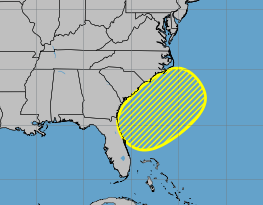
Tropical Storm Andrea is over South Carolina this morning and will briefly exit the coastline, rain ahead and to the east, with a long tail that reaches toward south Florida continues.
Another area of low pressure in the Central Atlantic, 92L, looked impressive yesterday for June, but has since weakened, we'll monitor it in case of any regeneration, but it will take days, if at all as it tracks generally westward.
Prior Update
Tropical Storm Andrea strengthened to a 60MPH Tropical Storm and is approaching the big bend of the area, heading north northeast at 14mph, bringing strong rainbands onshore in Florida bringing a few short lived tornadoes, and lots of rain.
Once it moves onshore other areas of the southeast will see some effects from Andrea, particularly those who wind up at or just south of where the storm's center passes. Tropical Storm Warnings are up from Flagler beach in Florida north to Virginia.
What is Andrea doing in your area, let us know here.

The strong rain bands have produced a few tornadoes, with some damage reported near Palm Beach west of 95.
Another very strong rainband is offshore and may be approaching Tampa later this morning.

Tropical Storm Andrea has defied forecasts calling for little or no strengthening, and has become a potent 60 MPH Tropical Storm, and this could be conservative. Additionally, while not forecast, some additional strengthening is actually still possible before landfall.
Andrea has managed to run into a zone of upper-level winds that are actually resulting in two events supportive of intensification:
First, strong upper-level winds that would normally be creating detrimental shear are running in about the same direction Andrea has been traveling overnight, also important that her forward speed has increased, both resulting in net effective shear that is actually quite a bit lower than would be the case if the cyclone was heading to a more right angle of the mean upper-level flow.
Second, these same upper-level winds have created a nice source of exhaust for Andrea's thunderstorms, thereby creating a perpetual entrainment machine: inflow in, inflow out (vacuum) more inflow in, more inflow out (rinse and repeat).
Andrea now exhibits the hallmark of a tropical cyclone that does not necessarily need to reach hurricane status to result in more than just some heavy tropical squalls, and those in its path may wish to consider revisiting their hurricane preparedness plans, as regardless of whether Andrea intensifies further, very heavy rain - with increased risks of inland flooding - some storm surge flooding along the coast, potentially damaging winds - especially in gusts - and isolated tornadoes, are now all possible anywhere from south Florida right up into the Big Bend.
Later in the week, Andrea is forecast to continue at storm intensity as she rides up the east coast. This has necessitated Tropical Storm Warnings to be extended all the way to Virginia.
Ciel
Long term Florida radar recording SWFWMD Full Florida Radar Recording for 91L - Alternate Style
Andrea Event Related Links
Animated Skeetobite Model Plot of Andrea
SFWMD Model Plot (Animated Model Plot) SFWMD Hurricane Page (More Tracking Information)
Clark Evans Track Model Plot of Andrea (Animated!) Model Plots in Google Earth - In Google Maps
Clark Evans Intensity Model Plot of Andrea Clark Evans Track Plot of Andrea (Animated!)
Clark Evans Top 10 Analog Storms for Andrea
More model runs on from RAL/Jonathan Vigh's page
NRL Info on Andrea -- RAMMB Info
Floater Satellite Images:
Visible
(Loop),
IR
(Loop),
WV
(Loop),
Dvorak
(Loop),
AVN
(Loop),
RGB
(Loop),
Rainbow
(Loop),
Funktop
(Loop),
RB Top
Loop)
Storm Surge Tides and Currents for Andrea
Webcams
Bird Key Webcam
Siesta Key Webcam
Clearwater Beach Webcams
Treasure Island webcams
Anna Maria Island Webcams
Power outage map for Florida (Progress Energy)
Florida Emergency Management
Tampa Area Media:
Tampa Bay Online
Northeast Gulf Links
Southeast Composite Radar Loop
(Latest Static)
Tampa Bay, FL Radar Long Range Radar Loop ( Latest Static)
Key West, FL Radar Long Range Radar Loop ( Latest Static)
Mobile, AL Radar Long Range Radar Loop ( Latest Static)
Tallahassee FL Radar Long Range Radar Loop ( Latest Static)
Northwest Florida Radar Long Range Radar Loop ( Latest Static)
Gulf of Mexico Satellite Imagery
SFWMD Full Florida Radar (Includes east LA, MS,AL) Loop with Storm Track
Area Forecast Discussions:
Mississippi/Alabama/Pensacola -
Panhandle/Tallahassee -
Tampa/West Central Florida
East Florida Links
Southeast Composite Radar Loop
(Latest Static)
South to North:
Key West, FL Radar Long Range Radar Loop ( Latest Static)
Miami, FL Radar Long Range Radar Loop ( Latest Static)
Melbourne, FL Radar Long Range Radar Loop ( Latest Static)
Jacksonville, FL Radar Long Range Radar Loop ( Latest Static)
Caribbean/South East Coast Satellite Imagery
SFWMD Radar Loop of South Florida with storm Track
SFWMD Full Florida Radar Loop with Storm Track
Area Forecast Discussions:
FLorida Keys -
Miami/South Florida -
Melbourne/East Central Florida -
Jacksonville/Northeast Florida -
Mid-Atlantic/Carolina Links
Southeast Composite Radar Loop
(Latest Static)
Charleston, SC Radar Long Range Radar Loop ( Latest Static)
Wilmington, NC Radar Long Range Radar Loop ( Latest Static)
Morehead City, NC Radar Long Range Radar Loop ( Latest Static)
Norfolk/Wakefield, VA Radar Long Range Radar Loop ( Latest Static)
Area Forecast Discussions:
Charleston, SC -
Wilmington, NC -
Morehead City, NC -
Norfolk/Virginia Beach/Hampton Roads, VA
93L Event Related Links
Animated Skeetobite Model Plot of 93L
SFWMD Model Plot (Animated Model Plot) SFWMD Hurricane Page
(More Tracking Information)
Clark Evans Track Model Plot of 93L
(Animated!) Model Plots in Google Earth - In Google Maps
Clark Evans Intensity Model Plot of 93L Clark Evans Track Plot of 93L
(Animated!)
Clark Evans Top 10 Analog Storms for 93L
More model runs on from RAL/Jonathan Vigh's page
NRL Info on 93L -- RAMMB Info
Floater Satellite Images:
Visible
(Loop),
IR
(Loop),
WV
(Loop),
Dvorak
(Loop),
AVN
(Loop),
RGB
(Loop),
Rainbow
(Loop),
Funktop
(Loop),
RB Top
Loop)
Vigorous Andrea Upping the Ante
Posted: 08:36 PM 02 June 2013 | 32 Comments | Add Comment | Newest: 10:05 AM 06-Jun EDT

Tropical Storm Andrea has defied forecasts calling for little or no strengthening, and has become a potent 60 MPH Tropical Storm, and this could be conservative. Additionally, while not forecast, some additional strengthening is actually still possible before landfall.
Andrea has managed to run into a zone of upper-level winds that are actually resulting in two events supportive of intensification:
First, strong upper-level winds that would normally be creating detrimental shear are running in about the same direction Andrea has been traveling overnight, also important that her forward speed has increased, both resulting in net effective shear that is actually quite a bit lower than would be the case if the cyclone was heading to a more right angle of the mean upper-level flow.
Second, these same upper-level winds have created a nice source of exhaust for Andrea's thunderstorms, thereby creating a perpetual entrainment machine: inflow in, inflow out (vacuum) more inflow in, more inflow out (rinse and repeat).
Andrea now exhibits the hallmark of a tropical cyclone that does not necessarily need to reach hurricane status to result in more than just some heavy tropical squalls, and those in its path may wish to consider revisiting their hurricane preparedness plans, as regardless of whether Andrea intensifies further, very heavy rain - with increased risks of inland flooding - some storm surge flooding along the coast, potentially damaging winds - especially in gusts - and isolated tornadoes, are now all possible anywhere from south Florida right up into the Big Bend.
Later in the week, Andrea is forecast to continue at storm intensity as she rides up the east coast. This has necessitated Tropical Storm Warnings to be extended all the way to Virginia.
Ciel
5 June 2013 6:30 PM EDT Update
Tropical Storm Warnings are up for the West Coast of Florida from Boca Grande (Coast between Ft. Myers and Port Charlotte) and the Ochlockonee River (Just south of Tallahassee). Tropical Watches are up from Flagler Beach on the East coast of Florida north to Surf City, NC.
Storm surge flooding of 2-4 ft above ground level, or inundation, expected with TS Andrea from Tampa Bay Northward to Apalachicola
From NWS Melbourne:

5 June 2013 5:30 PM EDT Update
Andrea Forms.
From a special Tropical Weather Outlook:
AN AIR FORCE RECONNAISSANCE AIRCRAFT WAS ABLE TO IDENTIFY A
WELL-DEFINED CIRCULATION IN THE LOW PRESSURE AREA OVER THE EAST-
CENTRAL GULF OF MEXICO LATE THIS AFTERNOON. BASED ON THIS
FINDING...THE NATIONAL HURRICANE CENTER WILL INITIATE ADVISORIES ON
TROPICAL STORM ANDREA WITHIN THE NEXT HOUR OR SO. THIS SYSTEM HAS A
HIGH CHANCE...NEAR 100 PERCENT...OF BECOMING A TROPICAL CYCLONE
DURING THE NEXT 48 HOURS.
Tropical Storm Watches/Warnings for the West coast of Florida will likely be up soon.
5 June 2013 8:00 AM EDT Update
Development chances are 50/50 now, but even with the flareup overnight, the circulation is still not defined very well. Nonetheless, development may occur within the next 48 hours before its forecast move inland across the Big Bend or Eastern Panhandle tomorrow night.
5 June 2013 5:00 AM EDT Update
Flhurricane.com for complete story & discussion.
As of early this morning, here are the bullet points:
91L's structure is a blend of subtropical and marginally tropical
91L's weather continues to be most pronounced on its eastern half
Conditions for development have turned from unfavorable to marginally favorable
Conditions for development are forecast to become even better over the next day or two
The broad low pressure area being tracked as Invest 91L has been struggling to organize over the past several days, but conditions are now staring to become marginally favorable for subtropical or tropical development.
As of early Wednesday morning, 91L still consists of a broad surface circulation with multiple, competing swirls about an axis of lower pressure, but this could be starting to change.
Late last night convection started flaring up a little closer to the center, and not so far removed as to be completely auxiliary. Concurrent with this event, pressures have been falling, and wind speeds rising. More recently, night vision IR imagery suggests that a center reformation may be trying to take place closer to the deepest convection. Any one of these by itself may not mean much, but taken together, this is characteristic of a sloppy system getting better organized.
The driving forces that have been holding 91L in check are starting to relax, with both shear and dry air decreasing. With upper level winds now aligning themselves a little with the lower levels, 91L is starting to take on a somewhat classic subtropical cyclone look.
At the surface, observations show winds now up to around 35 MPH sustained, with higher gusts. Most of the strongest winds are occurring well removed from 91Ls estimated center, which is also consistent with subtropical cyclones. In fact, a ship report from roughly 350 miles to its east recently reported winds of up to 49 MPH in a thunderstorm.
Recon is tentatively scheduled to fly through Invest 91L later today.
Ciel
4 June 2013 Update
The area in the Gulf, 91L, continues to hang in the gulf, but is starting to show more subtropical characteristics, which ultimately means more rain and breezy conditions over a larger area.

The west side of the system is still involved in a lot of dry air, as the general center itself is still off the tip of the Yucatan. The rainfall is starting to appear in southwest Florida, and will slowly spread northward, most of the rain will likely wind up being in south Florida.
Development wise, it has about a 30% shot to develop in the next 48 hours currently, and as mentioned earlier probably has a better chance to develop into a subtropical system, if at all, than a purely tropical one. Still either could occur, and it just means flooding conditions for parts of Florida as it drifts very slowly through the gulf, more northerly at first before flowing a bit east, which will give more central and north Florida a chance for rain later.
For central Florida late Wednesday night and most of Thursday is the highest chance for rainfall, some rain may linger in south Florida after the system moves over a bit longer, so South Florida still will by far see the most rainfall.
Based on the path of the storm, conditions will possibly be good for a small tornado threat Thursday night in parts of Florida.
Long term florida radar recording SWFWMD Full Florida Radar Recording for 91L Alternate Style
Original Update
Tropical Development is possible this week, and it may impact Florida. At the very least rainfall will be great most of the week, through Thursday when the most likely landfall time would occur on the West Central Florida coastline. As the area currently is very broad, the most likely place to watch for development is the general center near the northeastern tip of the Yucatan Peninsula.
Tropical development chances are only at 20% right now, but conditions are good enough that a possible tropical depression or lower end Tropical Storm may form mid week. Rainfall in central and south Florida will be greatly enhanced by this broad low pressure area this week, as of 8:30PM it began being tracked as an "Invest" area, 91L near 22.0N, 88.6W.
Florida will need to be aware of the potential for Flooding rains, as the system may be offshore in the gulf until
Thursday, driving rain up through the Florida peninsula the entire time. More to come as conditions warrant.
Unlikely, but if a tropical storm forms (best chance for this is Wednesday evening, if at all), it would be named Andrea.
Andrea Event Related Links
Animated Skeetobite Model Plot of Andrea
SFWMD Model Plot (Animated Model Plot) SFWMD Hurricane Page (More Tracking Information)
Clark Evans Track Model Plot of Andrea (Animated!) Model Plots in Google Earth - In Google Maps
Clark Evans Intensity Model Plot of Andrea Clark Evans Track Plot of Andrea (Animated!)
Clark Evans Top 10 Analog Storms for Andrea
More model runs on from RAL/Jonathan Vigh's page
NRL Info on Andrea -- RAMMB Info
Floater Satellite Images:
Visible
(Loop),
IR
(Loop),
WV
(Loop),
Dvorak
(Loop),
AVN
(Loop),
RGB
(Loop),
Rainbow
(Loop),
Funktop
(Loop),
RB Top
Loop)
Storm Surge Tides and Currents for Andrea
Webcams
Bird Key Webcam
Siesta Key Webcam
Clearwater Beach Webcams
Treasure Island webcams
Anna Maria Island Webcams
Ocean Key Resort Live Stream cams (3 on one page)
Florida Keys Webcams
Beach Cam Key West (Controllable) South Street Key West Cam (Controllable)
Duval Street Key West streaming cam (w/ Audio)
Bahia Honda Key Cam Recording (Alt)
Florida Keys traffic cameras
Tampa Area Media:
Tampa Bay Online
Northeast Gulf Links
Southeast Composite Radar Loop
(Latest Static)
Tampa Bay, FL Radar Long Range Radar Loop ( Latest Static)
Key West, FL Radar Long Range Radar Loop ( Latest Static)
Mobile, AL Radar Long Range Radar Loop ( Latest Static)
Tallahassee FL Radar Long Range Radar Loop ( Latest Static)
Northwest Florida Radar Long Range Radar Loop ( Latest Static)
Gulf of Mexico Satellite Imagery
SFWMD Full Florida Radar (Includes east LA, MS,AL) Loop with Storm Track
Area Forecast Discussions:
Mississippi/Alabama/Pensacola -
Panhandle/Tallahassee -
Tampa/West Central Florida
East Florida Links
Southeast Composite Radar Loop
(Latest Static)
South to North:
Key West, FL Radar Long Range Radar Loop ( Latest Static)
Miami, FL Radar Long Range Radar Loop ( Latest Static)
Melbourne, FL Radar Long Range Radar Loop ( Latest Static)
Jacksonville, FL Radar Long Range Radar Loop ( Latest Static)
Caribbean/South East Coast Satellite Imagery
SFWMD Radar Loop of South Florida with storm Track
SFWMD Full Florida Radar Loop with Storm Track
Area Forecast Discussions:
FLorida Keys -
Miami/South Florida -
Melbourne/East Central Florida -
Jacksonville/Northeast Florida -
Mid-Atlantic/Carolina Links
Southeast Composite Radar Loop
(Latest Static)
Charleston, SC Radar Long Range Radar Loop ( Latest Static)
Wilmington, NC Radar Long Range Radar Loop ( Latest Static)
Morehead City, NC Radar Long Range Radar Loop ( Latest Static)
Norfolk/Wakefield, VA Radar Long Range Radar Loop ( Latest Static)
Area Forecast Discussions:
Charleston, SC -
Wilmington, NC -
Morehead City, NC -
Norfolk/Virginia Beach/Hampton Roads, VA
The Atlantic Hurricane Season Begins Today
Posted: 11:33 PM 31 May 2013 | 6 Comments | Add Comment | Newest: 09:01 PM 02-Jun EDT
The Atlantic Hurricane Season lasts through November 30th. The peak of hurricane activity is typically between mid August and mid October. For the first two months of the Hurricane season, it is generally slow. Any development usually happens in the Western Caribbean and even more rarely outside of that. Generally toward the second half of July it starts to heat up and things get really going mid August through mid October.
Wild weather is already upon us outside of the Atlantic basin. Another round of violent tornadoes went through Oklahoma on the last day of May, and the tropical Atlantic starts the year with remnants of a record-setting eastern Pacific Hurricane, Barbara, hanging around in the Gulf of Mexico. Although the remnants of Barbara are not likely to reorganize, this does add to the moisture, vorticity, and instability in the area.
The current pattern suggests that a greater number of tropical storms and hurricanes may make it further west than what we have been getting accustomed to lately, a few names not withstanding, so remaining vigilant is extra important this year. Still, hurricanes are rather rare events, so over hyping them is something that flhurricane likes to avoid.
It is nearing the 8th year that Florida has gone without a direct hurricane landfall, the last one occurring in 2005, with Hurricane Wilma.
The last hurricane to hit the US in general was "Supestorm Sandy" just last year, and before that, Isaac, along the gulf coast. Florida's luck has been pretty good lately, maybe too good, so by statistics alone, odds are much higher this year that Florida may be hit by a hurricane.
This recent dry spell is in itself becoming dangerous. Many newer coastal residents are not experienced with tropical cyclones, and even old-timers are getting apathetic.
It is important to be hurricane prepared. Have a plan. Know if you are in an evacuation area, and know when to leave (and when not to!). Have some supplies ready if you are in an area that may see hurricanes, and stay informed.
Hype is still a large problem when it comes to the media and storms, and this site still takes the point of view that hurricanes are rare events and that hype is counterproductive. Smart monitoring of the basin is more useful.
With the proliferation of social media sites, it's easier for information, (and misinformation), to get out. The Internet is filled with hype. I dislike hurricanes, but still want to learn as much about them as possible. Here you will find discussion and data geared to what is really going on, and not toward sensational reporting of the situation.
Be prepared!
The National Hurricane Center is still the best source for accurate information. Think of Flhurricane as a sort of supplement to the NHC. And there are plenty of other resources on the Internet and elsewhere that we frequently recommend looking at as well.
Confirm anything you read or see in multiple places when trying to decide on a plan of action for any particular storm, and when a storm gets very close, local sources, such as a dependable local news station with a reliable weather team, can become indispensable.
If a storm does not hit you, and you are ok, take advantage of social sites and texting (not phoning!) to let people know the status of yourself and your area, so that word can still spread, as telephone lines and cell towers often fail during natural disasters, or get completely overloaded.
The list of 2013 Hurricane Names is: Andrea, Barry, Chantal, Dorian, Erin, Fernand, Gabrielle, Humberto, Ingrid, Jerry, Karen, Lorenzo, Melissa, Nestor, Olga, Pablo, Rebekah, Sebastien, Tanya, Van, and Wendy.
Last Advisory Written on Barbara
Posted: 07:29 AM 29 May 2013 | 10 Comments | Add Comment | Newest: 09:45 AM 04-Jun EDT
Barbara's surface circulation is no longer sufficient to qualify the system as a tropical cyclone, and the last advisory on TD Barbara has been written.
The remnant circulation associated with former Hurricane Barbara is now visible on high res satellite continuing north into the Gulf of Mexico.
Convection over x Barbara continues to wax and wane, and with the disturbance back over warm waters and under net effective shear running less than 20 knots, it is somewhat possible that it becomes the impetus for a new tropical cyclone. Should this occur, it would now be given an Atlantic number/name, being that the last advisory on eastern Pacific Barbara has been written.
Ciel
90L Event Related Links
Animated Skeetobite Model Plot of 90L
SFWMD Model Plot (Animated Model Plot) SFWMD Hurricane Page (More Tracking Information)
Clark Evans Track Model Plot of 90L (Animated!) Model Plots in Google Earth - In Google Maps
Clark Evans Intensity Model Plot of 90L Clark Evans Track Plot of 90L (Animated!)
Clark Evans Top 10 Analog Storms for 90L
More model runs on from RAL/Jonathan Vigh's page
NRL Info on 90L -- RAMMB Info
Floater Satellite Images:
Visible
(Loop),
IR
(Loop),
WV
(Loop),
Dvorak
(Loop),
AVN
(Loop),
RGB
(Loop),
Rainbow
(Loop),
Funktop
(Loop),
RB Top
Loop)
7:00 AM CDT May 30 Update
Nothing new with Barbara as of now, even if it does survive the crossing into the Bay of Campeche, the strong shear there should keep much from occurring. Discussion of Barbara and its crossing or remnants can be found in the Forecast Lounge.
Tropical Depression Barbara is moving from the Eastern Pacific hurricane Basin into the Bay of Campeche in the Gulf of Mexico, if it survives it will maintain itself into the Atlantic basin, and would maintain the name Barbara, which would be a first. The Atlantic naming still will start with Andrea when a storm forms there. Shear in the bay of Campeche is high, and will likely keep Barbara weak and from doing much more than some rainfall, the hurricane center's forecast is for it to dissipate.

4:00 AM CDT May 30 Update
Record-setting east Pac Hurricane Barbara has just about finished crossing the Isthmus of Tehuantepec, and within just the past two hours or so has shown strong signs of rebuilding deep convection atop its apparently still intact Low Level Circulation. If this trend continues for a little while longer, NHC will almost definitely begin Atlantic advisories on Barbara, making this system that basin's first tropical cyclone of the 2013 Atlantic Hurricane Season.
Shear over Barbara is running a favorable 8-16 knots, and looks to at least initially stay that way when the cyclone, or its remnants, first enters the extreme southern Gulf of Mexico (southern Bay of Campeche). Combined with very warm SSTs, moistening mid to upper levels, and a supportive MJO phase, it is also now very conceivable that Tropical Depression Barbara does become a tropical storm once again, with watches and warnings going up for the southwestern Gulf of Mexico.
In the nearer term, the main concern with Barbara is the continuation of very heavy rain, which has been producing deadly flash flooding, especially over the mountainous parts of the isthmus, and this will continue for some time to come whether or not the tropical cyclone dissipates later today.
Ciel
3:00 PM CDT May 29 Update
East Pac Barbara has become a hurricane and is now making landfall along the west coast of extreme southeastern Mexico.
An eye feature became pronounced today, and is nestled within very cold cloud tops. Just prior to landfall, T numbers out of SAB were running 4.5, suggesting the hurricane was still strengthening into landfall.
More on Hurricane Barbara can presently be read here, in the Other Storm Basins forum. Should Barbara enter the Gulf of Mexico as currently forecast, and become an Invest or numbered tropical cyclone (possible, but not forecast) we will be following its future travels in the Atlantic based forums.
Ciel
Original Update
The Atlantic Hurricane Season begins this Saturday, with not too much going on initially in the basin. Activity in the Atlantic may be slow for June, but likely will pick up into July and the best time to watch is mid August into October.
If anything were to develop in June, the most likely spot is in the western Caribbean, where currently a good area of convection can be found, but not much support for development.
Flhurricane generally limits ourselves to Atlantic systems, but of interest is an Eastern Pacific storm.
The eastern Pacific hurricane season started back on May 15th, and the second storm, Barbara, is nearing the southern coast of Mexico and hurricane watches are up, since there is a slight possibility that Barbara could gain hurricane strength just before landfall, as the system seems to be intensifying fairly rapidly.
A special advisory was recently issued raising hurricane warnings for the coast of the Gulf of the Tehuantepec, indicating Hurricane Conditions are expected within 24-36 hours. Those in that area of Mexico should make all needed preparations.
Puero Angel, MX Radar

More information on Barbara can be found at the National Hurricane Center's website
The start of the new season will soon be upon us and as of June 1st the entire state of Florida will have gone 2,777 days (7.6 years) without a landfalling hurricane - which is the longest hurricane landfalling drought in the Sunshine State since a 9 year stretch in the 1850s-1860s - and all of this during an active period in the Atlantic basin. But with regard to the frequency of landfalling U.S. hurricanes, does it make any difference if the basin is in an 'active' period or a 'quiet' period? The surprising answer is 'not much at all'. For the state of Florida there is a slightly greater risk during an active phase, but for the entire coastline from Brownsville, Texas, to Eastport, Maine, the risk is actually slightly higher when the Atlantic basin is in a period of lower tropical cyclone activity.
From 1995 - 2012 (active period): 144 hurricanes, 31 U.S. landfalls (21.5%), 9 Florida landfalls (6.3%)
From 1977 - 1994 (quiet period): 91 hurricanes, 22 U.S. landfalls (24.2%), 4 Florida landfalls (4.4%)
During the active period (1995 - 2012) 13 of the 18 seasons had a U.S. hurricane landfall and 5 of those seasons had a landfall in Florida - i.e., 13 seasons had no landfalling hurricane in Florida. During the inactive period of 18 seasons (1977 - 1994) 12 of the seasons had a U.S. hurricane landfall and 4 of those seasons had a landfall in Florida - i.e., 14 seasons had no landfalling hurricane in Florida. Finally, the inactive period also had a long stretch without any Florida hurricane landfalls - from October 12, 1987 to August 23, 1992 - 1,777 days (4.86 years). Although the sample set is small, there seems to be no significant correlation between the number of U.S. landfalling hurricanes and the Atlantic basin cycles of tropical cyclone activity, however, the length of time that Florida has gone without a hurricane landfall increases the probability that the state will experience one this season. With the expectation for another busy tropical season, now is the time to develop (or update) your hurricane preparedness plan.
ED
Skeetobite's storm track maps
NRL-Monterey (Nice Tracking Maps and Satellite)
USNO Information on Current Storms (including Google Earth KMZ Files)
Interactive Wundermap
GFDL
San Jose State Models and More
NOAA Historical Track Maps - Create your own tracking maps.
Check the Storm Forum from time to time for comments on any new developing system.
Follow worldwide SST evolution here: Global SST Animation - SST Forecast.
Storms From Previous Years (Unisys)
IR - Vis - WV - Loop - TWC IR - Color IR - Loop - SSTs - Buoy
NASA MSFC North Atlantic Visible (Daytime Only), Infrared, Water Vapor
LSU Sat images, RAMSDIS Satellite Images (rapid-scan imagery)
Full Western Hemisphere Sat Animation
Buoy Data, Dvorak Estimates
Caribbean Weather Observations
Some forecast models:
NHC/TAFB Experimental Gridded Marine Forecast
Multiple model output from Ryan Maue (HWRF, GFDL, GFS, etc)
GFS, ECMWF (ECMWF) and ECMWF
FSU: CMC, GFDL, GFS, NOGAPS, HWRF; Phase Analysis
DoD Weather Models (NOGAPS, AVN, MRF)
GFS, RUC, ETA
FIM Model
Raleighwx model page, Instant Weather Maps Models
Other commentary from Robert Lightbown/Crown Weather Tropical Update, TropicalAtlantic, Hurricanetrack.com (Mark Sudduth), Eric Berger, HurricaneVille, Mike Watkins / HurricaneAnalytics.com , Hurricane City, mpittweather, WXRisk, Gary Gray's Millennium Weather, storm2k, Hardcoreweather, Suncam TV (Streaming Video/cams), Jeff Masters (Weather Underground) , StormPulse (Matthew Wensing), , Max Mayfield, Greg Nordstrom, Gulf Coast Weather, Hurricane Alley, American Weather - 28 Storms Ham Weather
NOAA Weather Radio
Even more on the links page.