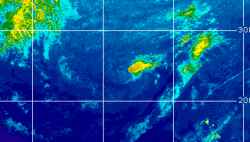
Today marks the start of the Eastern Pacific Hurricane Season. Atlantic Outlooks also begin today.
Days since last Hurricane Landfall —
US Any:
590 (Milton),
US Major:
590 (Milton),
FL Any:
590 (Milton),
FL Major:
590 (Milton)
Keith234
Storm Chaser
Reged:
Posts: 921
Loc: 40.7N/73.3W Long Island
|
|
What is the difference between a subtropical system and a hurricane? Ex. is it a warm or cold core system, goes it produce hurricane force wind and does it run on temperature difference(baroclinic)
-------------------- "I became insane with horrible periods of sanity"
Edgar Allan Poe
|
Jamiewx
Storm Tracker
Reged:
Posts: 371
Loc: Orlando, Florida
|
|
This information comes from the Hurricane Research Division FAQ webpage
"Subject: A6) What is a sub-tropical cyclone?
A sub-tropical cyclone is a low-pressure system existing in the tropical or subtropical latitudes (anywhere from the equator to about 50°N) that has characteristics of both tropical cyclones and mid-latitude (or ) cyclones. Therefore, many of these cyclones exist in a weak to moderate horizontal temperature gradient region (like mid-latitude cyclones), but also receive much of their energy from convective clouds (like tropical cyclones). Often, these storms have a radius of maximum winds which is farther out (on the order of 100-200 km [60-125 miles] from the center) than what is observed for purely "tropical" systems. Additionally, the maximum sustained winds for sub-tropical cyclones have not been observed to be stronger than about 33 m/s (64 kts, 74 mph)).
Many times these subtropical storms transform into true tropical cyclones. A recent example is the Atlantic basin's Hurricane Florence in November 1994 which began as a subtropical cyclone before becoming fully tropical. Note there has been at least one occurrence of tropical cyclones transforming into a subtropical storm (e.g. Atlantic basin storm 8 in 1973).
Subtropical cyclones in the Atlantic basin are classified by the maximum sustained surface winds:
less than 18 m/s (34 kts, 39 mph) - "subtropical depression",
greater than or equal to 18 m/s (34 kts, 39 mph) - "subtropical storm"
Prior to 2002 subtropical storms were not given names, but the National Hurricane Center issued forecasts and warnings similar to those for tropical cyclones. Now they are given names from the tropical cyclone list."
|
Anonymous
Unregistered
|
|
Thanks for the anwser it was very informative.
|
Keith234
Storm Chaser
Reged:
Posts: 921
Loc: 40.7N/73.3W Long Island
|
|
That was me above, I forgot to login!
-------------------- "I became insane with horrible periods of sanity"
Edgar Allan Poe
|
HanKFranK
User
Reged:
Posts: 1841
Loc: Graniteville, SC
|
|
gary padgett, who does a comprehensive reanalysis and historic inventory of tropical cyclones from around the world, has posted his may report finally.. that contains info on both the may caribbean system that caused the terrible loss of life via flash flooding in hispaniola.. and a poll of questions posed to many of the world's foremost experts on tropical weather about how to operationally classify and handle subtropical systems. go check it out.
Typhoon2K archives, gary padgett reports link
|
|
0 registered and 2 anonymous users are browsing this forum.
Moderator:
Print Topic
|
Forum Permissions
You cannot start new topics
You cannot reply to topics
HTML is disabled
UBBCode is enabled
|
Rating:
Topic views: 477300
|
|
|
|
|
|
Note: This is
NOT an official page. It is run by weather hobbyists and should not be used as a replacement for official sources.
CFHC's main servers are currently located at
Hostdime.com in Orlando, FL.
Image Server Network thanks to Mike Potts and Amazon Web Services. If you have static file hosting space that allows dns aliasing contact us to help out! Some Maps Provided by:
Great thanks to all who
donated and everyone who uses the site as well.
Site designed for 800x600+ resolution
When in doubt, take the word of the
National Hurricane Center