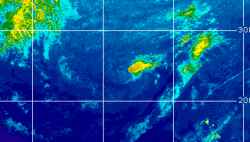
Today marks the start of the Eastern Pacific Hurricane Season. Atlantic Outlooks also begin today.
Days since last Hurricane Landfall —
US Any:
590 (Milton),
US Major:
590 (Milton),
FL Any:
590 (Milton),
FL Major:
590 (Milton)
Keith234
Storm Chaser
Reged:
Posts: 921
Loc: 40.7N/73.3W Long Island
|
|
This question has be posted in another fourm, I thought it might fit here better. What causes convective bursts at night in hurricanes?
-------------------- "I became insane with horrible periods of sanity"
Edgar Allan Poe
|
LI Phil
User
Reged:
Posts: 2637
Loc: Long Island (40.7N 73.6W)
|
|
avatars from jaws
-------------------- 2005 Forecast: 14/7/4
BUCKLE UP!
"If your topic ain't tropic, your post will be toast"
|
Keith234
Storm Chaser
Reged:
Posts: 921
Loc: 40.7N/73.3W Long Island
|
|
I got tried of looking at the same avatar, I guess this one isn't working either. Thanks for telling me!!
-------------------- "I became insane with horrible periods of sanity"
Edgar Allan Poe
|
Clark
Meteorologist
Reged:
Posts: 1710
Loc:
|
|
There is a phenomenon called the diurnal convective cycle, leading to nighttime being more favorable for convection in storms.
I was unable to find a definitive answer to what exactly it is, so the following is my own hypothesis from what I did find and what I've learned about tropical meteorology through the years...so perhaps take it with a grain of salt.
At night, you have less solar radiation (insolation) reaching the top of the atmosphere from the sun...well, to tell the truth, no solar radiation reaching the top of the atmosphere from the sun. This results in a cooler atmosphere as a whole. While the temperatures in the upper troposphere are always cold to begin with, when there is less insolation, the overall temperatures are going to be colder. Thus, you see a minimum in the mid-to-late afternoon, when the amount of insolation through the day is at its peak (around the time you see the daily high temperature at the surface), whereas you see a maximum in the overnight hours when the atmosphere has had time to sufficiently cool (around the time you see the daily low temperature at the surface).
If someone can provide a better or more correct/applicable explanation for the topic though, I'm all ears.
-------------------- Current Tropical Model Output Plots
(or view them on the main page for any active Atlantic storms!)
|
Keith234
Storm Chaser
Reged:
Posts: 921
Loc: 40.7N/73.3W Long Island
|
|
That would make sense, the earth takes time to cool off. Thanks for the anwser Clark.
-------------------- "I became insane with horrible periods of sanity"
Edgar Allan Poe
|
|
0 registered and 9 anonymous users are browsing this forum.
Moderator:
Print Topic
|
Forum Permissions
You cannot start new topics
You cannot reply to topics
HTML is disabled
UBBCode is enabled
|
Rating:
Topic views: 8415
|
|
|
|
|
|
Note: This is
NOT an official page. It is run by weather hobbyists and should not be used as a replacement for official sources.
CFHC's main servers are currently located at
Hostdime.com in Orlando, FL.
Image Server Network thanks to Mike Potts and Amazon Web Services. If you have static file hosting space that allows dns aliasing contact us to help out! Some Maps Provided by:
Great thanks to all who
donated and everyone who uses the site as well.
Site designed for 800x600+ resolution
When in doubt, take the word of the
National Hurricane Center