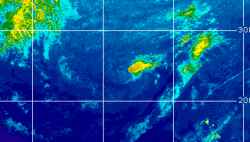
Can anyone explain to me why the western part of the Horn of Africa and the Atlantic close to it are "blacked out" on most of the satellite images? This is where a lot of the storms form, and it is frustrating not to be able to see this part of the world. I know that it didn't used to be like this. Is this political or technical?
Two factors: GOES-EAST cannot view that far west without serious distortion, thus giving the appearance of black regions on the satellite image (e.g. http://www.ssd.noaa.gov/goes/east/catl/avn-l.jpg), while METEOSAT/MSG-1 data are available only every 6hr to the public except by special agreement. Thus, on pages like http://weather.msfc.nasa.gov/GOES/globalir.html, you'll only see images there every 6hr or so. That's a decision made by the European Union nations that are part of the METSAT group.
The only thing that I ever heard was that it was strictly for monetary reasons. Usually weather data is free - worldwide. However, when METEOSAT was first launched, certain entities were willing to pay a fee for more frequent access to the data and the EU liked the idea as a means of offsetting costs. I guess that money rules - even in the weather business.
ED


 Previous
 Index
Index
 Next
Next
 Threaded




 Edit
Edit
 Reply
Reply
 Quote
Quote


