I am new here - have a quick question. From what I've read - the NHC recorded Wilma's pressure as 884mbar at 0800 UTC 19 Oct. 2005. Since the dropsonde did not reach the center, pressure was estimated to be 882mbar. Later at 1200 UTC pressure was recorded as 882mbar, and as late as 1500 UTC Wilma was still estimated to have a central pressure of 882mbar. By 2100 UTC central pressure had risen to 892mbar.
The question: for how many hours did Wilma sustain (882mbar) pressure, and at what time (approx.) did central pressure begin to rise?
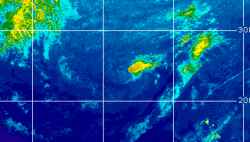
I attached a satellite image taken at 1615 UTC 19 Oct. Was central pressure still estimated to be 882mbar at this time?
I apologize if this question seems out of place.
-Francesco
Edited by Francesco (Wed Sep 01 2010 12:46 AM)
Post Extras:
Ed Dunham
Former Meteorologist & CFHC Forum Moderator (Ed Passed Away on May 14, 2017)
No, its a good set of questions and this Forum is okay for it since it deals with a very historic hurricane. First, here is an extract from the NHC bulletins:
At 0800Z, recon reported a central pressure of 884MB - and this was the value that was used in the bulletin at 09Z. When the aircraft landed the calibrated value was confirmed to be 882MB and this value was used in the bulletins at 12Z and 15Z. At 18Z, the NHC bulletin estimated pressure at 900MB and at 1806Z, recon reported a value of 894MB, so it is quite likely that almost immediately after 15Z the pressure began to rise. The period of record for 882MB is 08Z to 15Z - a total of 7 hours, but at 1615Z the pressure would have already been on the increase. Notice the pressure drop of 44MB in two hours from 03Z to 05Z - quite remarkable!
ED


 Previous
 Index
Index
 Next
Next
 Threaded


 Edit
Edit
 Reply
Reply
 Quote
Quote


