Update
TCD
Tropical Discussion — Thu Oct 30, 2025 4:54 PM
TCDAT3

Hurricane Melissa Discussion Number  38
NWS National Hurricane Center Miami FL       AL132025
500 PM AST Thu Oct 30 2025

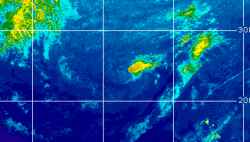
A recent AMSR2 microwave pass over Melissa indicates that the
center is tilted toward the northeast with height.  The 89 GHz
(mid-upper level) image shows a center at least 30 n mi northeast of
where the 37 GHz (low-level) image has the center.  This indicates
that strong west-southwesterly shear has begun.  Dropsonde and
flight-level wind data from a NOAA reconnaissance flight show that
the surface winds are much weaker than the winds aloft, and that the
standard 90 percent reduction factor should not be used.  Winds on
the east side of Melissa are quite strong between 1,500 ft and
10,000 ft, but drop off significantly near the surface.  The
strongest flight-level wind was 113 kt.  ASCAT showed vectors up to
70 kt around 15Z, which is consistent with lower-level
layer-averaged data from the dropsondes.  The latest subjective
Dvorak estimates are T5.0/90 kt from both TAFB and SAB.  The initial
intensity will be held at 90 kt, which is equivalent to 80 percent
of the maximum flight-level wind from the recent flight, but this
may be a bit generous.

Melissa is accelerating northeastward, or 35 degrees at 27 kt.
Melissa is likely to speed up to a forward speed of 35 kt or more
over the next 12 hours, and the fast motion should continue into
Saturday as Melissa moves within the flow between a mid-level trough
over the eastern U.S. and a subtropical ridge over the central
Atlantic.  The guidance is in excellent agreement for the first 48
of the forecast, with the center expected to pass northwest of
Bermuda tonight, where a hurricane warning is in effect.  After
Melissa becomes extratropical in about 30 hours, the center should
pass very near the southeastern tip of the Avalon Peninsula of
Newfoundland, where some impacts from wind, rain and surf are
possible.  Little to no change has been made to the official track
forecast through 48 hours, which lies near the various consensus
aids.

Melissa is now moving into progressively stronger west-southwesterly
wind shear and will reach sea-surface temperatures below 26C this
evening.  Therefore, Melissa should begin a weakening trend by early
Friday.  GFS and ECMWF simulated satellite imagery suggests that
Melissa should become post-tropical around Friday evening, prior to
making its closest approach to Newfoundland.  The NHC intensity
forecast is similar to the previous one, and lies within the upper
portion of the intensity guidance suite.  The NHC intensity and
radii forecasts after Melissa becomes post-tropical are largely
based on the global model solutions.


Key Messages:

1. Bermuda: Hurricane conditions are expected in Bermuda tonight,
with tropical storm conditions beginning early this evening.
Preparations should have been completed.

2. Post-storm safety:  Follow advice of local officials as you may
need to remain sheltered after the storm due to downed power lines
and flooding. Any flooding across the Bahamas is expected to subside
today. Flooding across Cuba, Jamaica, and Hispaniola could persist
for another few days. Ensure generators are properly ventilated and
placed outside at least 20 feet away from dwellings and garages to
avoid carbon monoxide poisoning. During clean up, be careful when
using chainsaws and power tools. Drink plenty of water to avoid heat
exhaustion.


FORECAST POSITIONS AND MAX WINDS

INIT  30/2100Z 30.2N  69.7W   90 KT 105 MPH
 12H  31/0600Z 34.4N  65.6W   85 KT 100 MPH
 24H  31/1800Z 40.4N  59.3W   75 KT  85 MPH
 36H  01/0600Z 46.3N  52.3W   65 KT  75 MPH...POST-TROP/EXTRATROP
 48H  01/1800Z 51.3N  45.8W   60 KT  70 MPH...POST-TROP/EXTRATROP
 60H  02/0600Z 53.8N  40.0W   55 KT  65 MPH...POST-TROP/EXTRATROP
 72H  02/1800Z 55.1N  33.9W   55 KT  65 MPH...POST-TROP/EXTRATROP
 96H  03/1800Z 57.6N  23.0W   45 KT  50 MPH...POST-TROP/EXTRATROP
120H  04/1800Z 61.7N  15.5W   35 KT  40 MPH...POST-TROP/EXTRATROP

$$
Forecaster Hagen
Note: This is
NOT an official page. It is run by weather hobbyists and should not be used as a replacement for official sources.
CFHC's main servers are currently located at
Hostdime.com in Orlando, FL.
Image Server Network thanks to Mike Potts and Amazon Web Services. If you have static file hosting space that allows dns aliasing contact us to help out! Some Maps Provided by:
Great thanks to all who
donated and everyone who uses the site as well.
Site designed for 800x600+ resolution
When in doubt, take the word of the
National Hurricane Center